Start here
Pick the question you came with. Each page stands on its own.
What patients and surgeons gain by leaving the operating room, and what the evidence says.
Anesthetic, the injection, the technique, and what one routine afternoon looks like.
What the studies show about infection, complications and epinephrine in the finger.
The papers behind the practice, read in full, and where the evidence is still thin.
What it takes to open a room, and what it saves the patient and the system.
The instruments, the sterilising kit and the staff, step by step.
Search
Type at least three letters.
Why the office
Same surgeon, same operation, different building. The difference on the bill is the facility fee.
Carpal tunnel release, trigger finger release, cubital tunnel release, ganglion excision, de Quervain's release: these are done under local anesthetic with epinephrine, with no tourniquet, no sedation and no anesthesia team. Sixty to eighty percent of the operations in a typical hand clinic qualify. In a hospital or an ambulatory surgery center, those cases carry a facility fee that is many times the surgeon's professional fee. In the office there is no facility fee. The patient pays less, the surgeon is paid for the setting as well as the surgery, and the main operating room is kept for the cases that need it.
The pattern is familiar. Most independent hand surgeons are tied to a surgery center, as part-owners or as the surgeons who fill its lists. The center collects the facility fee. The surgeon collects a professional fee for a case that could have been done in a chair down the corridor. Everyone in the room knows it. The question is whether the office pays.
It does, and the patients say so. When Heritage offered every office-eligible patient the choice of the office or the main operating room, nine in ten took the office. Four in five of the Medicare patients paid a $350 fee for the setting to do so, with nothing to save by it: the hospital would have cost them no more. That fee is one practice's arrangement and its legal position is not settled, which the economics page says plainly. The signal is in the choosing. We have been sending patients to the operating room by default, and they have told us, in a financial language that cannot be faked, that the default is wrong.
You do not have to be independent to start. The first office procedure room in this story was set up inside Michigan State University in 2016, by an employed surgeon, in a health-system professional building, with no facility fee attached. The practice described below is what happened when that surgeon left the university to test the office on its own.
None of this is new. By the middle of the twentieth century hand surgeons were already trying to clear large volumes of hand trauma the same way: in 1950 the Accident Department at Guy's Hospital in London ran a policy of wide-awake hand trauma care under local anesthesia, without epinephrine, to streamline the service (Clarkson 1950). The chapter that records it, by this site's author, sets the 1950 photographs beside his own office in 2020 and asks: have we really come so far?
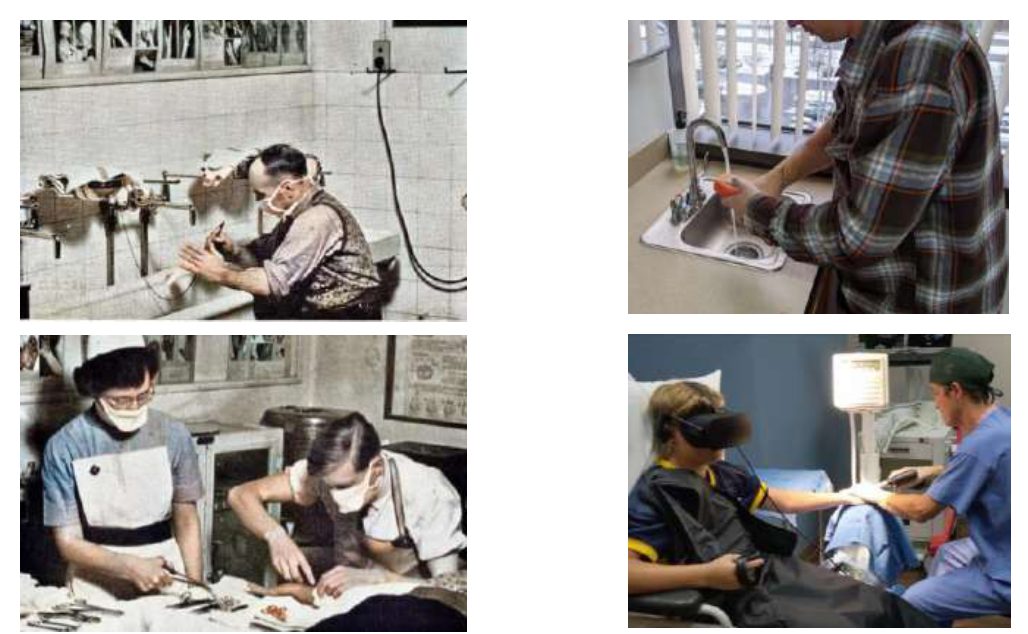
What the office does that the operating room cannot
Fourteen advantages, each with the paper that measured it. None is an opinion.
What patients say about it, and how to take the fear out of it, has a page of its own.
A history of the clean field
How the strict operating-room standard came about, what it was built for, and why it may be more than simple surgery needs.
A timeline
| Date | Event | What it shows |
|---|---|---|
| 1847 | Semmelweis introduces handwashing in chlorinated lime in Vienna's obstetric clinic (1861) | The first evidence that hands carry infection. It concerned childbirth, not surgery. |
| 1867 | Lister publishes on carbolic acid for compound fractures (Lancet) | Antisepsis: killing the germs already in and around the wound |
| 1892–1905 | Lane develops the "no-touch technique" for placing plates, with long instruments so that no gloved hand touches the wound. (1905) (Brand 2009) | The no-touch technique is asepsis. Plates were found to be beneficial when used with the right asepsis technique, and asepsis gained its first approval. (1905) |
| c.1900 | The German and American aseptic ritual (heat sterilisation, gowns, gloves) spreads through hospitals | The whole-room standard becomes routine; for bone it falls short |
| 1959–69 | Charnley's Wrightington series: 2,085 hips in phases of cleaner air. Deep infection falls from 8.9% in conventional rooms to 1.3% in the cleanest (Charnley and Eftekhar 1969) | Infection falls with cleaner rooms. Observational; wound closure not ruled out |
| 1982 | Lidwell randomised trial in hip and knee replacement: deep sepsis 0.6% with ultraclean air, 1.5% with conventional ventilation (Lidwell 1982) | The one randomised environmental trial on implants that I have found |
| 2015 | Wilson: a no-touch method in breast reconstruction with expanders (Wilson 2015) | A small before-and-after series |
Around 1900: the standard is imposed
Antiseptic methods had come first. Lister's carbolic acid was antisepsis: killing the germs already in and around the wound. Semmelweis's work was obstetric. His handwashing in chlorinated lime was for doctors examining women in labour, and it cut puerperal fever, but it was not a surgical technique. By the turn of the century the German and American aseptic ritual of heat sterilisation, gowns and gloves was spreading through hospitals, and it was becoming the standard for every operation. For soft-tissue surgery it was good enough. For bone it was not.
Why plates failed the standard
Surgeons who put metal into fractures found that the ordinary rules did not hold. Lane's 1909 paper names the problem: "the danger of the rubber glove is the possible presence of a puncture through which infection might enter the wound" (Lane 1909). The committee's 1912 report says the same thing in its conclusions: a considerable proportion of operative failures were due to wound infection, even with the best technique (Committee 1912).
A method others could not copy
Lane's answer was a different discipline, not a bigger room. In the 1890s he developed long instruments so that the gloved hand did not touch any part of the wound. That is the no-touch technique, and it was in use alongside his fixation work, which began with screws and wires in 1892 (Brand 2009). Sterilised cloths on the incision edges kept the skin out of the field (Committee 1912). The name came later. The committee put the difficulty plainly: fracture treatment "requires special skill and experience", and it should be done only by those with "constant practice and experience in such surgical procedures" (Committee 1912). Few surgeons had that practice, and the method did not spread with the ritual. The fixation of fractures was also met with "violent opposition", which faded only when X-rays showed high non-union rates in the alternatives (Brand 2009).
Plates fall from favour for five decades
For much of the first half of the century, fixation stayed controversial. The method that brought them back was not the old no-touch discipline but a cleaner room. In the 1960s John Charnley's group at Wrightington ran hip replacements through four phases of cleaner operating-room air. Among 2,085 consecutive hips, deep infection fell from 8.9% in the conventional rooms to 1.3% in the cleanest phase (Charnley and Eftekhar 1969). It was an observational study, and the authors could not rule out better wound closure as a cause.
A randomised trial followed in 1982. In hip and knee replacement, deep sepsis was 0.6% with ultraclean air and 1.5% with conventional ventilation (Lidwell 1982). That is the one randomised trial of an environmental control on implant surgery that I have found.
The standard becomes industrial
What began as a response to massive implants has become the standard for every operating room. Clean-air rooms, accreditation rules and monitored theatres now apply to the whole room, whatever is done in it. The ritual is applied to all surgery, and the infrastructure around it is part of what makes an operation cost what it does.
Where hypersterility is needed
The case for the full standard is strongest where a large foreign body goes into the patient. Total hip and total knee replacement are the clearest examples, and the Lidwell trial is about them. Breast implants are another. Infection after breast implant placement is a recognised problem in the plastic surgery literature, and no-touch methods are advocated for that reason. A 2022 systematic review of the Keller funnel, a no-touch insertion device, found six studies, five of them retrospective and none randomised. It reported lower capsular contracture (RR 0.42), and its abstract gives no infection figures (Keller funnel review 2022). A no-touch breast reconstruction series reported no surgical site infections in 25 breasts against two infection failures in 16 earlier breasts, a small before-and-after comparison (Wilson 2015).
Where the evidence runs out
Outside large implants, the evidence that the full standard is needed is missing. The AORN appendix lists 165 references, and by my reading thirteen report an infection outcome. Most of the rest measure bacteria on plates, gowns, gloves and drapes (AORN). The randomised trials with a surgical infection outcome test a wound device, not sterile technique (Bressan 2018; De Pastena 2020). No trial in this history compares sterility levels for simple surgery without implants.
The thesis
The argument from this history is that the strict standard was built around implants, and that it is applied to surgery that does not need it. Where the operation is not a massive prosthesis and does not need anaesthesia support, intravenous fluid support, muscle paralysis or major regional anaesthesia, office sterile-field technique may be good enough. The candidate areas are musculoskeletal, urological, vascular, ENT, ophthalmic, lumps and bumps, general, dermatological and lower gastrointestinal surgery. Each has its own risks, and sterility is only one of them. The case for each has to be made separately.
This is a hypothesis. Its test is a comparison that does not yet exist: the same procedure, done in the office and in a full theatre, with clinical infection as the outcome and the criteria set in advance.
There is a harm side to this as well. Every step up in sterility adds cost, and the cost lands on patients and on the system. Where a step has not been shown to help, it is cost without a benefit, and the argument here is that this is the position for simple surgery. A system built around the strictest standard also brings its own risks: a complex institution, and routine general anaesthesia as part of the way care is delivered, even where the operation does not need it. For an ageing population, the simplest safe setting for simple surgery is a non-institutional room, with the patient awake. The principle is primum non nocere, and it argues for the simpler option where the simpler option is shown to be adequate.
How WALANT came back
Back to basics: a 1970s medical student's observation became a method taught to two generations of hand surgeons, as Donald Lalonde tells it.
The rhyme
For most of the twentieth century, hand surgery was taught a rule: never inject epinephrine into fingers, nose, penis or toes. Lalonde calls it "a mythical rhyme" that even the weakest medical student could remember (Lalonde 2017). Its origins are older than the evidence. Procaine, the only local anaesthetic before 1948, was blamed for finger necrosis that the epinephrine got the credit for. Phentolamine, the rescue agent, was invented in 1957, after the myth had set into the textbooks.
The review that counted
In 2001 Keith Denkler reviewed the literature on finger injection. He found 48 cases of finger death attributed to local anaesthesia over 120 years, and none involved lidocaine with epinephrine (Denkler 2001). Lalonde's account is that this review is what made the rule untenable.
Watching it done
As a medical student in 1975, Lalonde watched Patrick Shoemaker at Queen's University inject epinephrine into fingers for flexor tendon repairs. Robert MacFarlane, known for Dupuytren's surgery, did his finger work the same way. Lalonde describes "a major disconnect between the reality of what was safely being done and what I was reading" (Lalonde 2017).
Testing it, 2003 to 2005
In 2003 Lalonde's group reported that phentolamine reliably reversed epinephrine vasoconstriction in the human finger. Eighteen Dalhousie hand surgeons had two fingers injected three times with epinephrine, and one finger injected with phentolamine (Lalonde 2017). In 2005 the Dalhousie Project reported 3,110 consecutive elective cases of epinephrine injection in fingers and hands, by nine surgeons in six cities, with no phentolamine rescue needed (Lalonde et al. 2005). Lalonde reports no finger necrosis in more than 2,000 of his own cases. These are prospective case series, not randomised trials, and the numbers come from the surgeons who ran the programme.
A method, not only a myth
What the technique became is a set of practical rules: tumescent injection until the tissue is visibly and palpably full, a bicarbonate buffer to reduce the sting (Frank and Lalonde 2012), and active movement checked during the operation. Flexor tendon repair is the clearest example. Intraoperative total active movement examination was used to avoid repair rupture (Higgins et al. 2010). Lalonde's Saint John rehabilitation protocol followed in 2016.
Training two generations
The first book on wide awake hand surgery appeared in 2016, with more than 150 videos. Electronic media did the rest: the ASSH listserv, Vumedi videos, PubMed and Google links to the papers. A Chinese edition, edited by Jin Bo Tang, appeared in 2017. Tang reports more than 5,000 cases in three years without one necrosis (Lalonde 2017). Lalonde names surgeons across Asia, Australia, Europe, Latin America and North America who took the technique up and presented it at their own meetings.
Much less, not much more
Lalonde's summary of the method is a single line: wide awake surgery "is one of the few innovations that requires 'much less' instead of 'much more' in terms of resources and time". The same paper expects that evidence-based sterility will replace "the customary 'more must be better' custom-based sterility practices for non-implant hand surgery", and that most small hand procedures will be done this way by 2050 (Lalonde 2017). That is the bridge to the thesis on this site. Lalonde argues for it from clinical practice, not from a trial of sterility levels.
The evidence for sterile technique
What the AORN evidence appendix shows, what it does not, and what would settle the question.
What the appendix contains
The AORN evidence appendix lists 165 numbered references. Most measure bacteria on settle plates, gowns, gloves and drapes. That is contamination, which sterile technique is designed to reduce, but contamination is not infection. A small number of studies report surgical site infection, and few of those are randomised trials.
Three entries that look like evidence and are not
The table lists Alwitry's cataract mask trial as reporting surgical site infection. Its outcome is bacteria on settle plates, and the paper reports no infective complications (Alwitry 2002). The table describes Romney's paper as a randomised trial. It is a review of the mask evidence (Romney 2001). A German hospital hygiene recommendation is listed as a trial of iodine against plastic adhesive drapes. I could not find that trial on PubMed, and the entry is a guideline.
The trials that report infection
Two randomised trials of a barrier device, the dual-ring wound protector, measured surgical site infection after pancreaticoduodenectomy. In 107 patients with biliary stents, Bressan and colleagues found incisional infection fell from 44.0% to 21.1% (Bressan 2018). In an interim analysis of 212 patients, De Pastena and colleagues found superficial infection at 7% in both arms, and the trial was stopped for futility (De Pastena 2020). The two results disagree. Neither tests sterile technique, airflow or sterile services. Both test a wound device.
What the history shows
The strictest aseptic standard grew up around implants. Lane's no-touch method, written out in his Appendix E to the British Medical Association's 1912 report on simple fractures, was built around the risk of leaving metal in the wound. Lane kept gloved hands and instruments out of the wound, and sterilised cloths on the incision edges kept the skin out of the field (Committee 1912). The committee concluded that operative treatment needs surroundings that "ensure asepsis", and that "a considerable proportion of the failures of operative treatment are due to infection of the wound, a possibility which may occur even with the best technique." Lane's own 1909 paper says the same thing in plainer terms: "the danger of the rubber glove is the possible presence of a puncture through which infection might enter the wound" (Lane 1909). Neither source gives infection rates. Its warning concerns fixation surgery. It does not address soft-tissue surgery, and it is not a comparison of sterility levels.
The thesis
The argument from this history is that office sterile-field technique, which keeps the skin out of the field and gloved hands out of the wound, resembles the early aseptic practice that was used for soft-tissue surgery. On that reading the most rigorous sterile environment is needed most for implants. An office procedure room that does not meet the highest accreditation standards, such as AAAHC or The Joint Commission, could then safely do simple surgery without implants, and should avoid implants. That is a hypothesis to test. It is not a finding.
Where the thesis is weak
The evidence for it is not in the appendix. No trial in the table compares sterility levels for soft-tissue surgery. The only randomised trials that report surgical site infection test a wound device, not sterile technique (Bressan 2018; De Pastena 2020). History shows that the rule was set by implant risk, but it does not show that simple surgery was safe without it. Until a comparison of sterility levels for soft-tissue surgery exists, "safe for simple surgery" is a claim to test.
The one randomised trial on implants
The trial that comes closest to the implant side of the thesis is not in the AORN appendix. Lidwell and colleagues randomised operating rooms to ultraclean air or conventional ventilation in hip and knee replacement. Deep sepsis was 0.6% in the ultraclean-air operations and 1.5% in the conventional rooms (P < 0.001). Whole-body exhaust suits lowered it further (Lidwell 1982). It is an environmental control, not a comparison of skin preparation or gowning, and it is implant surgery. It says nothing about soft-tissue surgery.
Two observational studies on implants
Charnley and Eftekhar followed 2,085 consecutive hip replacements through four phases of cleaner operating-room air. Deep infection fell from 8.9% in the conventional rooms to 1.3% in the cleanest phase. It is an observational study, and the authors could not rule out better wound closure as a cause (Charnley and Eftekhar 1969). Wilson's before-and-after series compared 25 breast reconstructions with expanders done with a no-touch method against 16 earlier cases. The no-touch group had no surgical site infections; the earlier group had two infection failures. The numbers are very small, although the authors report a significant difference (P = 0.025) (Wilson 2015). Both are useful and both are weak as evidence. Neither is a trial.
What would settle it
A randomised trial comparing full sterile technique with a lesser standard, with clinical infection as the outcome, in a defined surgical population. Nothing in the appendix is that trial. Until one exists, the case for sterile technique in low-risk office surgery rests on microbiology, observational series and biological plausibility. The same standard applies to the case for office WALANT, and this site relies on case series for much of its safety argument. The difference is that the site says so.
Where this leaves the guideline
The guideline is consensus advice built on contamination data and expert opinion. Its own appendix does not show that a specific sterile step prevents infection in a given operation. That does not show the guideline is wrong. It shows the evidence behind it is thinner than its authority suggests.
The patient experience
What patients say afterwards, what they fear beforehand, and how an office takes the fear out of the chair.
What patients say
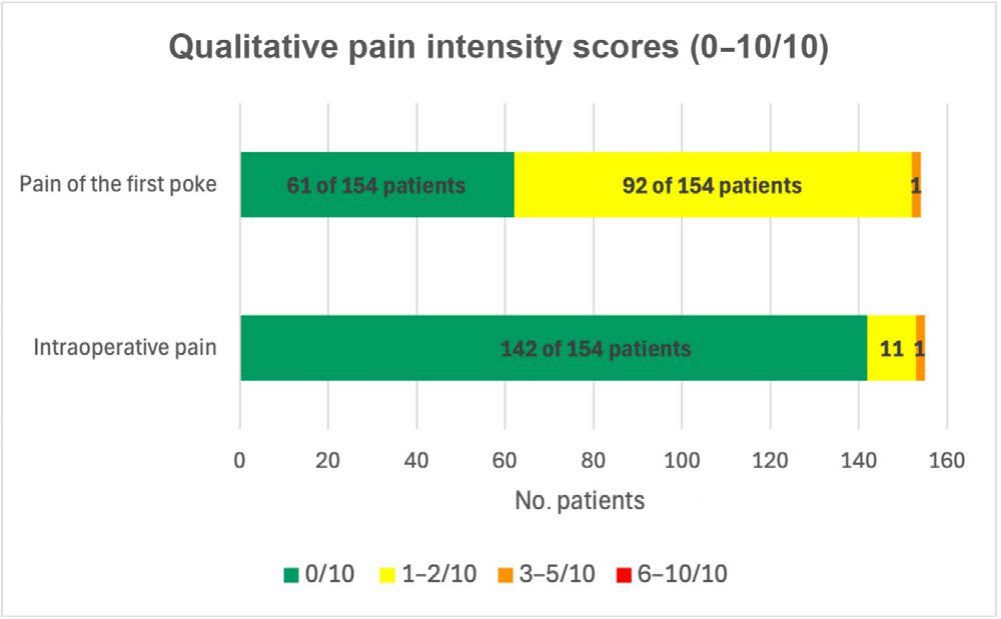
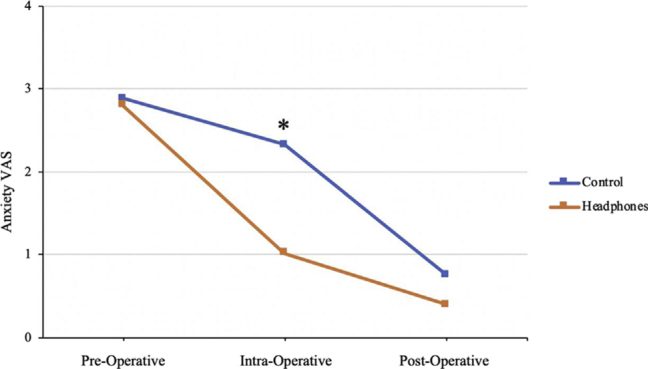
Ask them afterwards and the answer is the same everywhere. In five South African public hospitals, 84 of 85 patients would have WALANT again and would recommend it; their median pain during the operation was zero (Govender 2025). In a Lithuanian day unit 98 percent would choose it again a month later, and 93 percent called it no worse than the dentist (Knystautas 2023). In a randomized trial of headphones during awake surgery, 50 of 50 would choose it again; noise-cancelling headphones halved their anxiety on the table, from 2.3 to 1.0 out of 10 (Townsend 2021). In 154 consecutive patients tracking their own pain, 40 percent felt nothing at all during the injection and 60 percent felt only the first needle; they rated the experience 9.2 out of 10 (Brutus 2025).
Against the surgery center, the office wins on time, not on satisfaction. Knopp 2023 surveyed 151 patients across both settings: satisfaction 9.7 out of 10 in each, but 0.9 days off work after the office against 12.4 after the surgery center. And they go home without opioids: an office series that sent nobody home with a prescription found 2.8 percent asked for one by the next day and 5.6 percent within a week (Sraj 2019).
The honest part. The injection is the part they remember: four in five of one trial's patients called it the most painful moment (Pistorio 2024). Nearly half arrive moderately to severely anxious (Govender 2025). And a block done by an anesthesiologist can beat a hurried WALANT: in one Turkish series using 25 mL and a fifteen-minute wait, the supraclavicular block scored higher on satisfaction, 90 against 80 out of 100, and one awake patient in ten was converted (Azizoğlu 2026). The technique rewards the surgeon who does it properly.
Fear is a patient acceptance obstacle, and it is treatable
Nobody fears a carpal tunnel release. They fear being awake for it. Nearly half of patients arrive moderately to severely anxious and half fear pain despite the anesthetic (Govender 2025); anxiety is the reason patients are dissuaded from awake surgery (Hoxhallari 2019), the reason 28 percent of surgeons offer it only to "patients who can tolerate being awake" (Grandizio 2020), and the usual reason for the rare conversion. An operating room answers that fear with a sedative. An office answers it with something to look at.
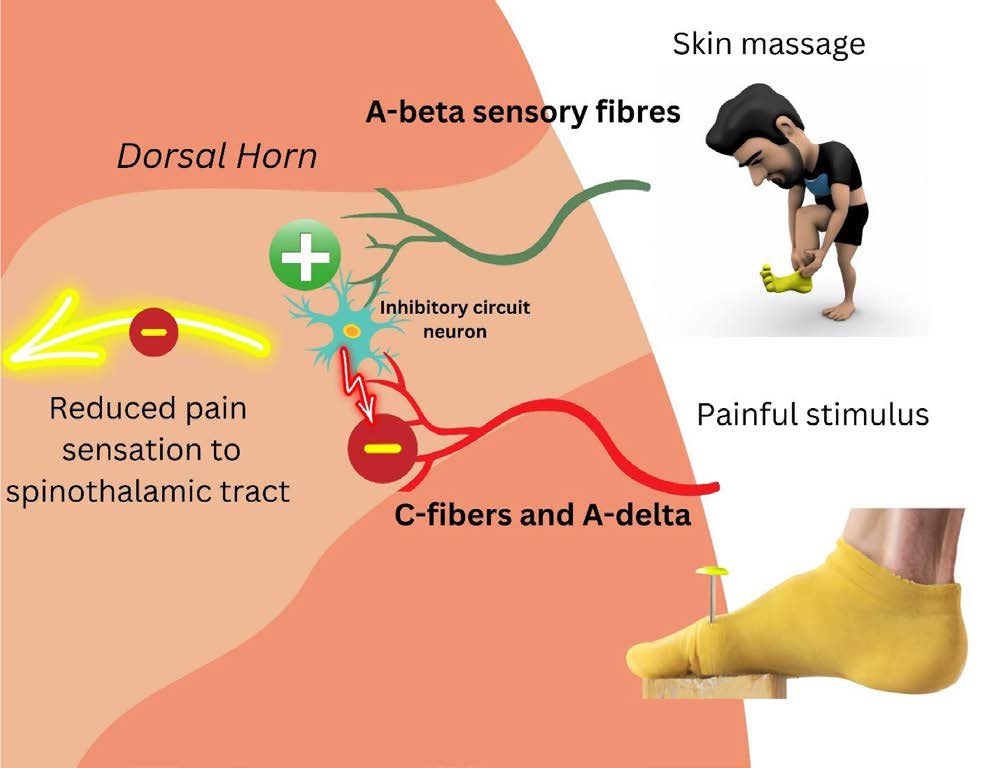
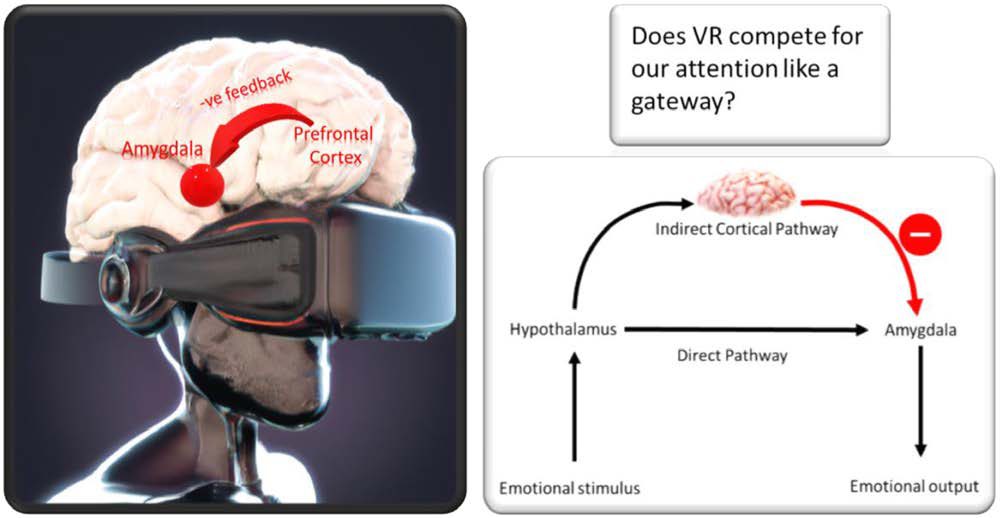
The mechanism is older than the technology. Melzack and Wall showed in 1965 that a competing sensation can close the gate on a painful one. Fun and joy act in opposition to fear and anxiety in the same way, and the hypothesis from this site's author's group is that an immersive experience works on the anxiety axis: a cortical pathway feeding back on the amygdala, the emotional analogue of the gate in the dorsal horn (Park 2023). Whatever the mechanism, a counter-distracting experience, something more interesting than the operation, shatters the apprehension the patient has built up on the way in. Three kinds have been tried in the office: a headset, a pair of headphones, and a screen.
Virtual reality
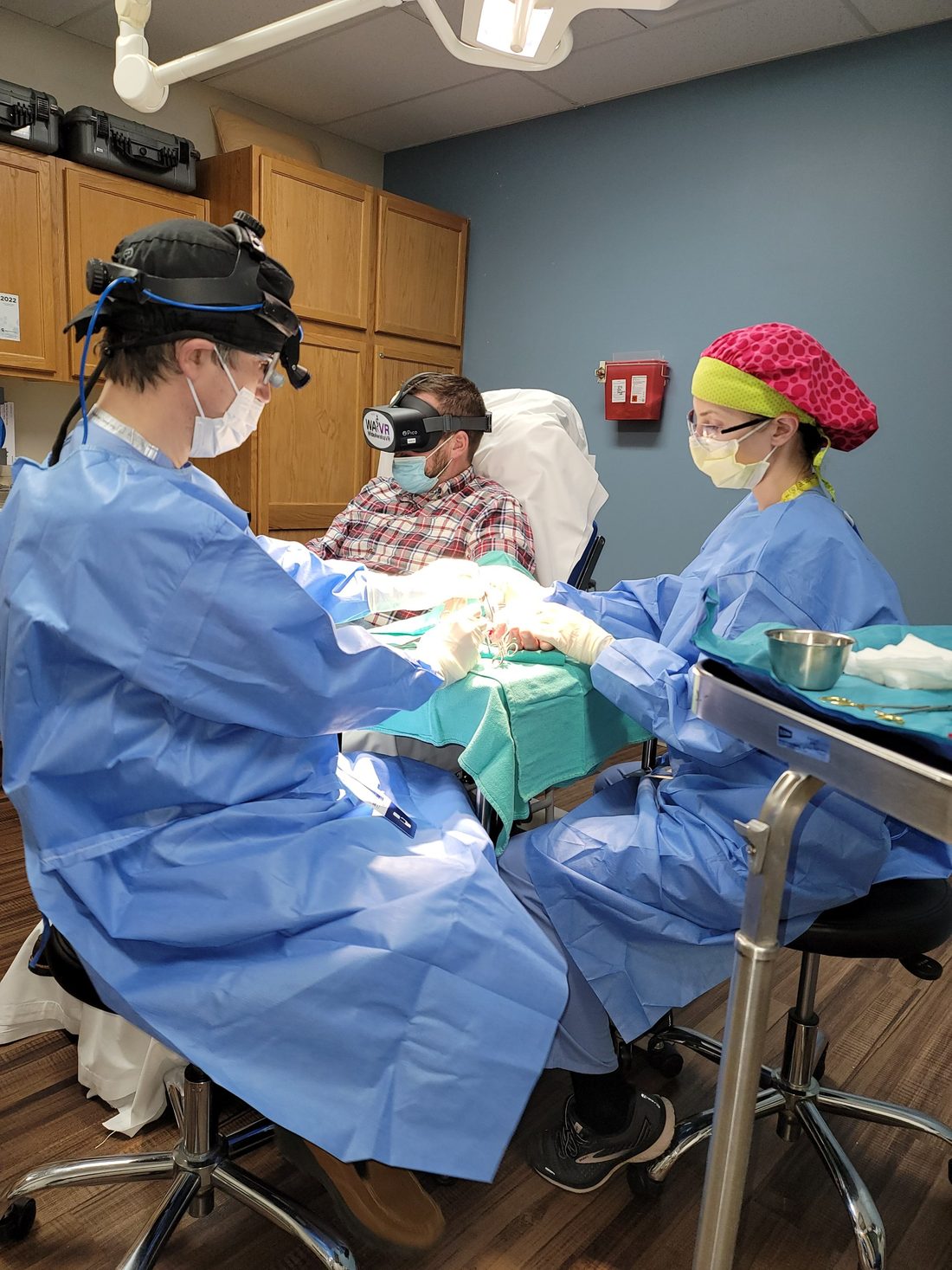
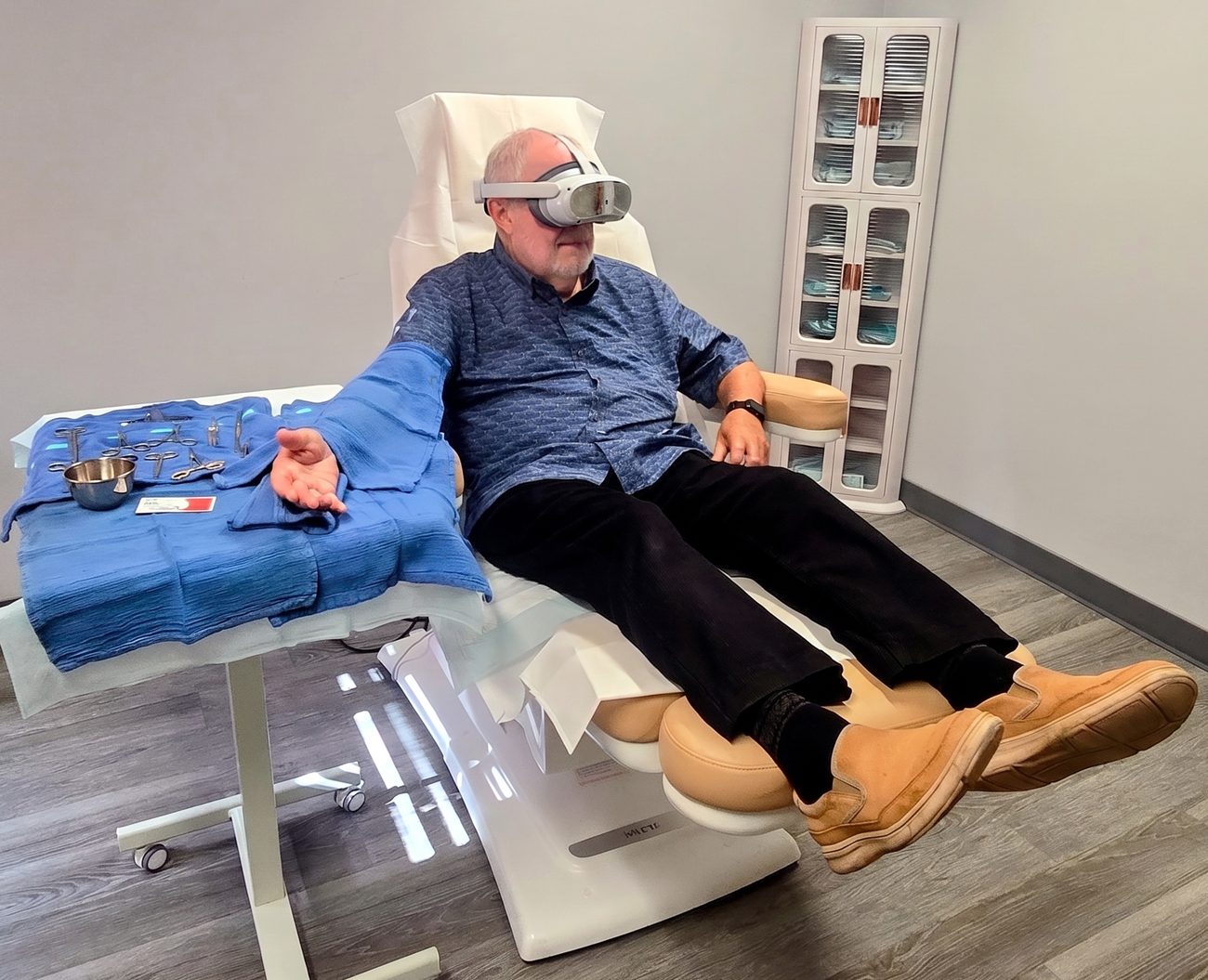
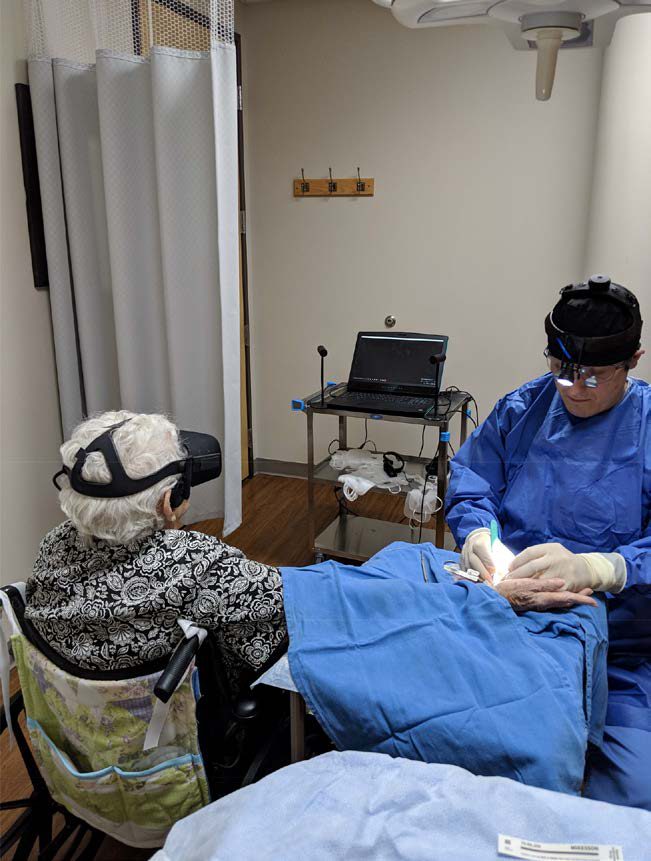
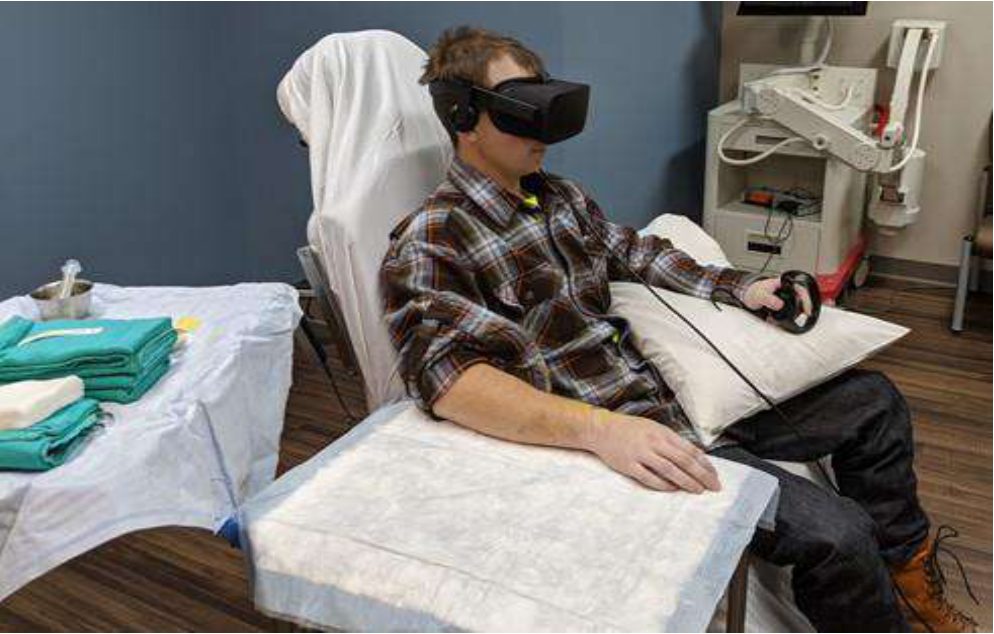
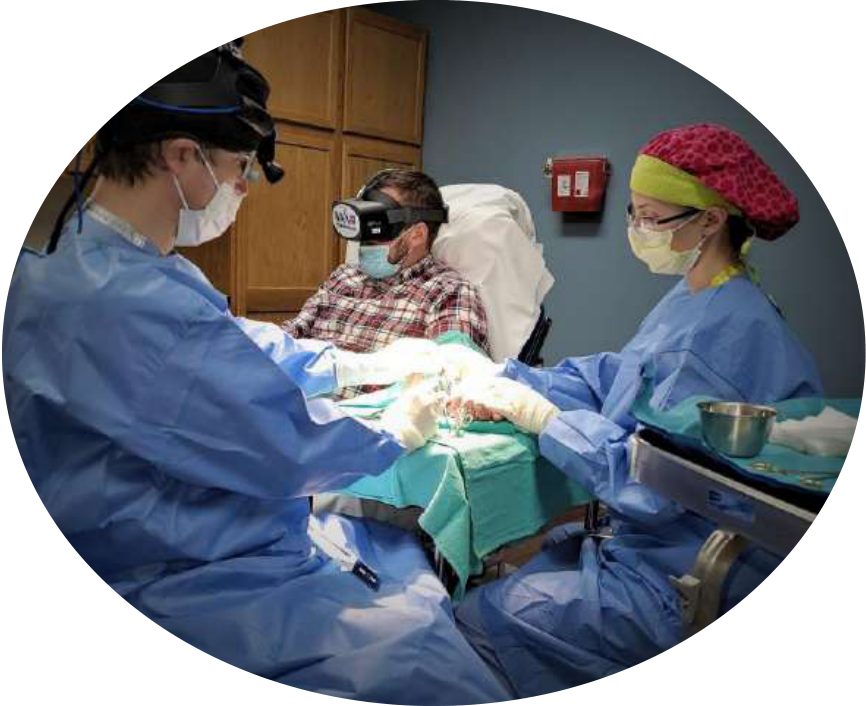
The office at Michigan State University began offering patients a virtual reality headset during awake hand surgery in 2016. Three studies came out of it.
| Study | Design | What it found |
|---|---|---|
| Hoxhallari 2019 Plast Reconstr Surg, randomized, single-blind | 41 patients in an office procedure room, randomized to a headset (21) or none (20); a phone-based headset, free 360-degree films, the injection timed to a moment of relief in the film | Anxiety lower with the headset at injection, mid-procedure and the end; fun higher throughout; enjoyment 8 out of 10 against 3. No difference in blood pressure, heart rate or pain overall, but in patients with a pre-existing anxiety disorder, pain during the injection was lower with the headset. Over 80 percent said it helped them relax and would recommend it. Three felt dizzy, two nauseous, none vomited |
| Miller 2022 Plast Reconstr Surg Glob Open, patient-reported | 241 surveys from 538 carpal tunnel releases by one surgeon: 43 in the hospital operating room, 198 awake in the office, of which 123 chose the headset | Office patients were half as likely as hospital patients to report a neutral or negative experience (11 against 23 percent), and more often enjoyed it (80 against 56 percent). With the headset, enjoyment rose again, 85 against 73 percent. Patients with an anxiety disorder chose the headset more often (74 against 56 percent) and got more from it: anxiety reduced in 79 percent against 47, enjoyment 90 against 59. 96 percent would recommend it, 91 percent would use it again. A third had some difficulty: glasses, dull content, a technical fault, motion sickness, fit |
| Park 2023 Plast Reconstr Surg Glob Open, randomized comparison | 25 wound-debridement patients randomized to a headset or none, compared with the hand-surgery trial | The headset made wound care more fun but did not change its anxiety or pain. Hand surgery patients were twice as anxious to begin with (3.3 against 1.7 out of 10), and there the headset cut anxiety and raised fun. The conclusion: the more anxious the setting, the more the headset does |
What the three say together: the headset does not change the operation and does not change the pain, except at the needle in the anxious. What it changes is the fear, and it changes it most in the people who have the most of it. Those are the patients who would otherwise ask for the operating room. Nearly three-quarters of the patients with an anxiety disorder chose it when offered.
How it is done, from the papers. A consumer headset and free 360-degree films; the early phone-in-a-headset kits overheated and were superseded, and the later stand-alone headsets needed the patient seated, because their view could not be re-centered for someone lying down. Choose films for engagement and against spatial motion, offer a choice (one water-phobic patient was given an underwater film and hated it), and let the room follow on a laptop so the team sees what the patient sees. Time the injection to a moment of relief in the film. Offer the headset for the injection to the needle-phobic and for the operation to everyone; cooperation with "make a fist" is immediate. Excluded in the trial: seizures, pacemaker, vertigo, a plastic allergy, severe short or long sight, anyone unwilling to wear a band. Expect one in three to have some small difficulty, usually glasses or the content, and the oldest patient in the trial, over 82, to dislike it; one patient would rather have talked to the surgeon.
One patient's sentence, from the second study: "I was very skeptical at first, but knowing I was going to have a virtual reality experience for my second surgery made me much more relaxed pre-op."
Disclosure: this site's author was co-founder and Chief Medical Officer of Wide Awake VR, the company behind the headset used in these studies, and the studies declare it. The 2019 randomized trial declared no financial interest.
How to run it, from the chapter
The hand-trauma chapter puts it in one line: wide-awake virtual reality is a technique, not just a technology. The headset does not remove the surgeon from the relationship; it recontextualizes the experience for the patient, provided the technique is right. The chapter's rules, condensed:
- Use it to get the patient into the chair. "Just put me out, doc." "How about I put you in another place, using virtual reality? It means we can fix your hand now. Would you be willing to try?"
- Start early. Give the patient time in the headset before the surgery begins, to orient, pick what they want to watch and start enjoying themselves. The needle-phobic and children need it on for the injection, with the countdown from three and the skin pinch as usual.
- Choose the content with them. Ask about motion sickness and choose sedentary material for anyone who has it; ask about fears (water, heights) and musical taste; avoid roller coasters and flight with roll, pitch and yaw; stabilized drone footage with a level horizon is well tolerated. Passive immersive experiences and music have worked best; about two and a half hours of media covers a list.
- Keep control of it for most patients, who are new to the technology; let the experienced ones drive.
- Announce yourself. On entering the room, introduce yourself and touch the shoulder before surgery starts.
- Maintain immersion. A well-immersed patient looks around, and their breathing becomes slow and deep. If their attention drifts to the surgery, bring them back: ask where they are, what they can see, whether to move on to the next experience; use humor about the content.
- Keep talking. They can hear everything said in the room unless they are wearing headphones. Use the show to re-context the conversation and give the postoperative advice while they watch; education embedded in the content is retained because the patient is calm.
- Headphones are wanted by a definite minority; surgical sounds alone have caused syncope. Noise-cancelling headphones also make teaching a resident easier, at the cost of the patient hearing your commands.
- Expect up to a third to decline. That is normal. Beware the very anxious patient who also declines; encourage a trial run before deciding, and accept that a very anxious patient who still declines may not be suitable for awake surgery.
- The most anxious benefit the most, in both the randomized trial and the patient-reported study. White-coat hypertension often normalizes in the headset, which makes the epinephrine injection safe to give.
- Supine is a problem for consumer headsets, which expect the user upright and looking forward; medical devices now re-center the gaze for a patient lying down.
The chapter also reports the office's own quality-improvement numbers for the first half of 2023: of 230 patients who had WALANT in the office between January and June, 80 percent chose the headset. Of those, 95 percent said it reduced their anxiety during the procedure; overall satisfaction with the experience was 9.7 out of 10 with the headset against 9.3 without (p = 0.03), and enjoyment 8.1 against 5.9 (p = 0.0001).
For balance: a 2026 systematic review of the seven randomized trials of virtual reality in adult hand and wrist surgery (543 patients, 2019 to 2025) found that the headset did not consistently reduce pain, that three of the six trials measuring anxiety found it reduced intraoperative anxiety, and that the certainty of the evidence was low on both counts; it concluded that virtual reality may reduce intraoperative anxiety in selected patients and called for larger trials stratified by baseline anxiety (Bhindi 2026). That is the same conclusion the three Michigan studies reached from the inside: it is a treatment for fear, and it works best on the people who have the most of it.
Headphones, music, and a screen
The headset is not the only way, and not the cheapest. In a randomized trial of 50 awake hand-surgery patients, noise-cancelling headphones playing the patient's own music halved anxiety on the table, from 2.3 to 1.0 out of 10, and every one of the 50 would choose awake surgery again (Townsend 2021). Headphones cost less than a dressing pack, fit over glasses, and leave the eyes free to watch or to close. A 2026 meta-analysis of 25 randomized trials of music around surgery found a moderate reduction in anxiety, and the largest effects under local or regional anesthesia (Yu 2026).
A screen is the third option: a television on the wall, a tablet on an arm, a projector on the ceiling, playing what the headset would, with nothing on the patient's face and the surgeon and patient still able to see each other. It suits the patient who wears glasses, the patient who refuses a headset, and the 82-year-old who wants a conversation. It is the least studied of the three in hand surgery, and the trials that exist are worth knowing before you buy one:
- In 115 office patients having small operations on the face, wrist or hand, a distracting video played during the injection of the local anesthetic lowered injection pain by one point out of 10 (p = 0.01). Satisfaction did not change (Molleman 2019).
- In 50 awake orthopedic day-surgery patients under local or regional anesthesia, randomized to a film through video glasses or to music of their choice through headphones, both reduced anxiety, and the music reduced it more (p = 0.018). Neither changed pain (Demirci 2023).
- In 152 patients having ingrown toenail surgery under local anesthetic, a bedside audiovisual program reduced neither pain nor anxiety, and was no better than conversation with the staff (Drahota 2008).
- In 476 cataract patients, twenty minutes of television before surgery cut intraoperative hypertensive events in first-time patients from 10.3 percent to none (p = 0.003); television and music both lowered pre-operative anxiety by a similar amount (Cheng 2026).
- A systematic review of 20 randomized trials of distraction during surgery under local anesthetic found that 30 percent showed a benefit, 50 percent showed none, and that relaxation-based methods may do more for intraoperative anxiety than audiovisual ones (Hudson 2016).
Read together: a screen takes the edge off the needle and settles the patient before they come in, music does at least as much for anxiety on the table, and the headset is the only one of the three with hand-surgery trials showing it reduces anxiety during the operation itself. The screen earns its place as the fallback for the patient who will not or cannot wear anything on their face. Jean Paul Brutus runs a music and light show during surgery in Montreal (Brutus 2022); the principle is the same in all of them: give the mind somewhere better to be.
Why it sets a practice apart
An operation is the same in every office. The experience is not, and patients talk about the experience. The Centers for Medicare and Medicaid Services scores outpatient surgery on patient-reported experience through its consumer survey, but that survey reaches hospital outpatient departments and surgery centers. It does not reach the private office. Nobody scores your office, which cuts both ways: there is no published number to defend, and none to hide behind either. What a private practice has instead is what the patient tells the next person. A practice that sends a patient home at eleven in the morning having spent the operation drifting down a river in a film has given them a story, and the story is the referral. The surgeon who fitted the headset is the one they remember. It costs a consumer headset or a pair of headphones, and it is the cheapest marketing a practice will ever do.
Why only three in a hundred
The evidence has been in for fifteen years. The surgeons have not moved. Here is why they say they haven't, and the answer to each.
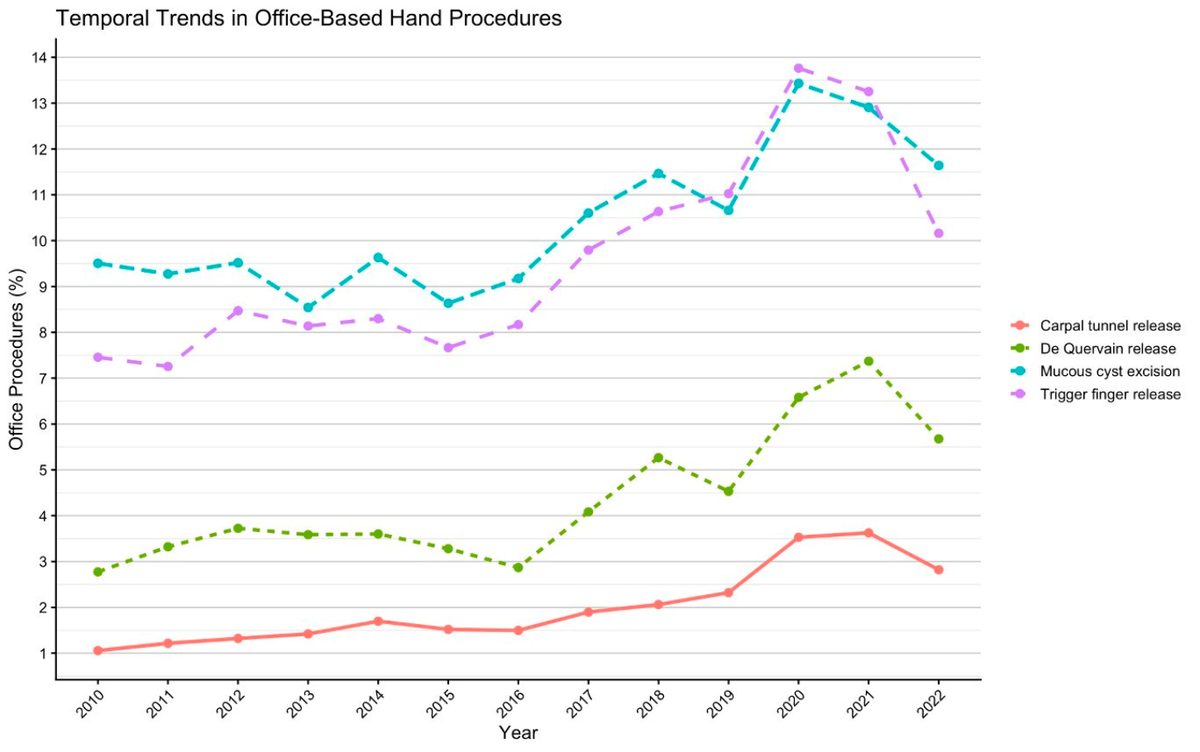
In 2010, 1.2 percent of the carpal tunnel releases done under local anesthetic in the United States were done in an office. By 2020 it was 3.4 percent: 5,463 office cases against 303,741 in an operating room. The office patients filled fewer opioid prescriptions, went to the emergency department less, and had the same infection rate (Kammien 2024). Across the four commonest office operations the share is still rising, and total cost in the office runs 30 to 48 percent lower whatever the payer (Kammien 2026). None of that has moved the number past a rounding error.
Ninety-seven in a hundred of the most common operation in hand surgery are still done in a building that charges a facility fee for it. That is not a verdict on the office. It is the size of the room you are walking into.
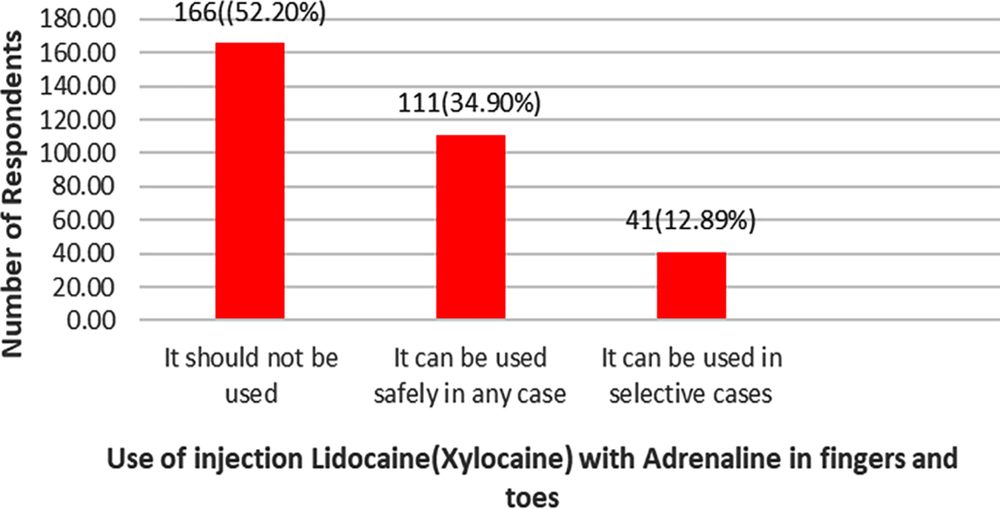
The surgeons have been asked why. When 869 members of the American Society for Surgery of the Hand answered a survey, 62 percent said they used WALANT, but only 24 percent used a clinic procedure room for it, and nearly half said their institution required anesthesia staff to be present for an awake case. The commonest reason given for not using it was a preference for the tourniquet, or worry about seeing the field without one, at 16 percent. Fear of epinephrine was 2 percent (Grandizio 2020). The barrier is habit and institutional rules, not the evidence. Elsewhere the dogma itself survives: of 398 orthopedic surgeons surveyed in Pakistan in 2025, 80 percent used lidocaine with epinephrine somewhere, and 52 percent still believed it should not be used in a finger or toe (Shah 2025).
Field sterility has been studied in more than ten thousand office and procedure-room hand operations with no excess deep infection. Two Veterans Affairs cohorts ran the office and the operating room side by side and found no difference. In 37,602 trigger finger releases in a national claims database, the office had fewer major complications than the operating room; in 468,365 claims for minor hand procedures, fewer than either the surgery center or the hospital. The American Academy of Orthopaedic Surgeons' 2024 guideline says carpal tunnel release may be safely done in the office.
The safety evidenceOn the professional fee, perhaps, by a little: one claims study found 3 to 9 percent less from commercial payers and 5 to 13 percent less from Medicare (Kammien 2026); another found the surgeon paid more for an office carpal tunnel release, $515 against $472, while the payer paid $322 less (Lalchandani 2019). Either way it is a few tens of dollars. What changes is what the fee has to carry: an office room costs a fraction of an operating room to run, and there is no facility fee to fund. The office payment is also the one holding its value: adjusted for inflation, Medicare's payment for trigger finger release in the office rose 4.2 percent between 2002 and 2018, while the same release billed at the facility rate fell 40 percent (Malik 2020).
The economicsNearly half of the surgeons in the society survey said their institution required one. The evidence does not. In 1,771 consecutive awake cases at one surgery center, with a single nurse monitoring and circulating and no anesthesia provider, no case was aborted, none was converted to sedation, and nobody was transferred to an emergency department (Schindelar 2022). The Association of periOperative Registered Nurses' 2020 guidance allows a single registered nurse for local-anesthetic procedures. Lalonde's unit runs three carpal tunnel releases an hour with one surgeon, one nurse and one receptionist (Degreef 2024).
StaffingSame procedure code, billed from your office at the non-facility rate, as you already bill an injection. There is no facility claim, because there is no facility. That part is ordinary, and it is the whole of what the office requires. Whether you can also charge the patient a fee for the setting itself is a separate question, and not a settled one; one practice's experience of it, and the caution that goes with it, are on the economics page.
The economicsCredentialing is a facility's gate, and you are not in a facility. In your own office, under local anesthetic with no sedation, most states regulate nothing, and the ones that do mostly exempt local anesthesia. Read your state medical board's office-based surgery rules once and keep a copy.
State rulesThey won't. The center collects the facility fee on your case and you collect the professional fee; that arithmetic is the resistance, and it is also the reason to move. Starr's health system earned $25 a minute on hand surgery in its own surgery center and $5.63 a minute in the office, and still moved the cases, because the operating time was worth more filled with something else. If you do not own the center, that $25 was never yours. The published advice on adoption is to educate the resistant stakeholders: administrators, nurse leaders, anesthesia colleagues (Hearon 2023). The faster route is to stop needing their permission.
The networkEconomics
Fifteen months of a new office practice, April 2025 to June 2026, as presented at the American Society for Surgery of the Hand in Boston, September 2026.
Payers: Medicare, commercial insurance and self-pay only. No third-party administrator or other third-party contract is included.
In April 2025 the surgeon rented half a practice building, hired three and a half staff and fitted two procedure rooms, one for surgery and one for imaging. One day a week at a rural hospital, running a hand clinic and an operating list as a contractor, paid the bills while the office found its feet. Everything below was built with no institutional facility, no surgery-center ownership and no referral contracts.
| Individual patients | 1,564 |
| Encounters | 3,216 |
| Operations in the office 520 procedures across these operations | 411 (77%) |
| Operations in the main operating room 205 procedures; every case that needed a hospital: wrist fusions, basal joint arthroplasties, flaps | 123 (23%) |
| Staff | 3.5 |
Operative visits counted once each. Injections, aspirations, splinting and minor skin and nail work are not counted as operations.
| Capital to open the doors | $104,141 |
| Running cost Rent, staff, supplies, insurance, everything | $25,126 a month |
| Running cost per hour the surgeon is in the office | $322 |
| Cash in covered cash out | Month 4 |
| Bridging loan for the first three months repaid | Month 7 |
| Growth in monthly takings Linear trend, r² 0.89 | +$4,018 a month, every month |
| Start-up capital repaid | By month 17 |
That is one surgeon's own volume at contracted rates, collected on a standard revenue cycle: patients pay on the day, and 97 percent of insurance arrives within 120 days. The start-up capital and the day job are in none of it. The $322 an hour is the number to remember. You had better be in your office.
The three doors
The professional fee is not quite identical in the two settings, because the office is paid at the non-facility rate, but for most hand codes the difference is negligible: one claims study found the surgeon paid 3 to 9 percent less in the office by commercial payers and 5 to 13 percent less by Medicare (Kammien 2026), another found the surgeon paid more, $515 against $472 (Lalchandani 2019). A few tens of dollars either way. What the office does not carry is a facility fee. Heritage went one step further and asked the patients who chose the office to pay for the setting itself. That is a separate decision from moving the operation, it carries its own risk, and it is set out here as one practice's arrangement rather than as a model to copy. Every patient was given three doors, and the main operating room was always one of them.
A fee added to the episode of a Medicare or commercially insured patient can be perceived as balance billing. The rules differ by payer, by contract and by state, and nothing on this page is a legal opinion or a claim that the position is settled. What follows is one surgeon's experience, alongside a second: Dr Steven Koehler, in New York City, has presented a similar arrangement at $400. Take your own counsel on the legal position of a choice fee, in your own state and under your own payer contracts, before you charge one.
$50 to book, $300 on the day. Anyone insured. Their plan is billed for the surgery exactly as it would have been from the hospital. Heritage's position is that the fee buys the setting rather than the surgery, so it is collected from the patient and not claimed from the plan.
The patient has chosen your practice rates ahead of time, pays the whole price themselves, and their plan is not used at all. This is their own decision. One number, paid on the day, and no claim at all: Heritage relies on the right of a patient who pays in full to restrict disclosure to their plan, under the HITECH Act (Health Information Technology for Economic and Clinical Health).
Anyone who prefers it, for any reason at all. The same room in which more than 95 percent of hand surgery in the United States is still done. The hospital bills as usual, the surgeon charges nothing extra, and nobody is steered.
Everyone using their insurance was quoted the same $350, and the main operating room stayed open to all of them at no extra charge from the surgeon. Heritage tried $500 first; it did not hold. Dr Steven Koehler, in New York City, has presented the same arrangement at $400. Two practices are not evidence of anything except that two practices did it.
| Medicare | Commercial | |
|---|---|---|
| Operations that could be done awake in the office | 142 | 154 |
| Chose the office | 131 (92%) | 136 (88%) |
| Paid the $350 fee | 103 | 97 |
| Paid in full themselves, no insurance used | 0 | 7 |
| Not charged (early months, friends of friends) | 28 | 32 |
| Wanted the main operating room, and got it | 11 | 18 |
| Share of those offered the fee who paid it | 79% | 75% |
Carpal tunnel, trigger finger, cubital tunnel and ganglion. Site of care verified from the billing system on every case, not inferred.
| Door | Worth to the practice |
|---|---|
| Insured, in the office 97 patients | $896 median: the $350 fee plus about $546 the plan has contracted to pay, arriving ninety days later |
| Fully self-paying 7 patients | $2,000, the price published today. One number, paid on the day. No claim, no adjustment, no accounts receivable |
| The local hospital or surgery center | Roughly $4,300 to $6,500, from the published price-transparency files and plan rates |
One fully self-paying patient is worth more than two insured ones. Same chair, same hour. Only seven of 136 commercial patients took that door, and finding more of them is a marketing problem, not a clinical one: it cost $20,000 over five months to put a price engine in front of patients in one state. One practice cannot outspend a hospital. A network can, and that is what WALANT Surgical Solutions is for. But the office does not need the network to pay its way. It pays on the patients you already have.
What your own clinic already holds
An illustration using Heritage's observed rates. Change the figures to your own. It counts cases and operating-room time only: your professional fee barely moves with the setting, and no fee for the setting is assumed.
What the literature says
The cost finding is not one practice's. It has been measured by direct cost, by time-driven costing, by national claims and by what patients and their employers lose, in academic centers, military hospitals, a Veterans Affairs system, a Spanish district hospital and Swedish consulting rooms. It points the same way every time, and the reason is always the same: the building, not the drug. The saving from dropping the anesthetic disappears once the setting is held constant; the saving from dropping the building does not.
| Study | What was compared | Finding |
|---|---|---|
| Direct cost of the case | ||
| Carr 2019 Hand (N Y) | One surgeon's open carpal tunnel release in four venues, direct costs and weighed waste, five cases each | $31.71 in clinic against $55.66 surgery center under local, $102.79 surgery center with sedation, $213.75 hospital operating room. Waste 0.65 kg against 4.78 kg |
| Kazmers 2018 J Hand Surg Am | 479 carpal tunnel releases at one academic center by technique, setting and anesthetic | Open release under local in the operating room cost 6.3× the same operation in the procedure room; with monitored anesthesia 11×; endoscopic 12.4 to 16.6× |
| Chatterjee 2011 Ann Plast Surg | Open carpal tunnel release, clinic against operating room, academic center | $670 against $3,469 total cost. The clinic case earned $1,186; the operating room case lost $650 |
| Halvorson 2020 Am J Infect Control | 312 carpal tunnel releases, Veterans Affairs procedure room against operating room | $417 against $4,254 mean total cost, a tenfold difference, with no difference in infection |
| White 2019 Hand (N Y) | Carpal tunnel release, clinic against surgery center, time-driven activity-based costing | $152 against $557 per case; 79 minutes from arrival to discharge against 216; the same pain scores |
| Far-Riera 2022 J Hand Surg Glob Online | Carpal tunnel and trigger finger in a Spanish district hospital's outpatient area against its operating room, 616 office procedures | $414 against $1,487 per case; one hour in the building against six; eight cases a day against five or six; the waiting list halved |
| Levit 2024 Hand (N Y) | Meta-analysis, trigger finger release, WALANT against local with a tourniquet, 11 studies, 1,233 patients | Cost 52 percent lower (95 percent interval 24 to 80), recovery 28 minutes shorter; low-certainty evidence |
| Yen 2020 BMC Musculoskelet Disord | Arthroscopic wrist ganglion excision in Taiwan, 23 awake against 51 under general anesthesia, reimbursed cost | €487 against €879 per case; 89 minutes of room time against 122; the same recurrence and outcomes |
| Santos Lopes 2026 Plast Reconstr Surg Glob Open | Acute hand and wrist trauma in a Portuguese public hospital, 49 WALANT against 50 conventional anesthesia, pathway costs only | Mean hospital cost €147 against €1,490 per patient, most of the difference the admission avoided; still €877 lower after adjustment in the 29 conventional patients who would have been eligible for WALANT |
| Time and staff | ||
| Serhan 2026 J Hand Surg Glob Online | Minor hand procedures at a military hospital, procedure room (77) against operating room (69), time-driven costing | Staff cost per case $50.64 against $202.61; 69 minutes in the hospital against 190; 28 minutes in the room against 55; 43 percent fewer staff |
| Maliha 2019 Plast Reconstr Surg Glob Open | Trigger finger release, city hospital procedure room (39) against operating room (37) | Turnover 31 minutes against 65; instrument tray $994 against $3,304; staffing $44 a minute more in the operating room |
| Starr 2023 J Hand Surg Am | 808 office against 623 surgery-center hand cases, six surgeons, health system view | 82 percent lower cost per case ($206 against $1,137); 821 hours of surgery-center time freed over two years |
| Ponich 2025 Plast Reconstr Surg Glob Open | Calgary minor procedure day with field sterility | 10 to 15 procedures in a ten-hour day against three or four in the main operating room |
| Rhee 2017 J Hand Surg Am | First 100 clinic WALANT cases at a military medical center | 85 percent saved on carpal tunnel release, 70 percent on trigger finger; $393,100 over the study; no adverse events |
| What the payer and the patient pay | ||
| Billig 2020 JAMA Netw Open | 468,365 commercially insured minor hand procedures, office against surgery center and hospital outpatient | Hospital outpatient added $1,216 per episode and $115 from the patient's pocket; surgery center added $709 and $140; office complications lower |
| Lalchandani 2019 J Hand Surg Glob Online | 34,942 claims, carpal tunnel release awake against with anesthesia | Reimbursement $1,452 against $1,774, and the surgeon was paid more awake ($515 against $472); complications halved; opioid prescriptions filled 50.5 against 61.5 percent |
| Kammien 2026 J Clin Med | National claims 2010 to 2022, four common operations, office against operating room, matched | Total cost 30 to 48 percent lower in the office for every payer; fewer opioid prescriptions filled (odds 0.47 to 0.61); same infection rate |
| Knopp 2023 Cureus | 151 patients, office against ambulatory surgery center, one practice | Satisfaction 9.7 out of 10 in both; days off work 0.9 against 12.4 |
| Waste and carbon | ||
| Hedspång 2026 JPRAS Open | 62 carpal tunnel releases in ordinary consulting rooms, no operating-room nurse, Sweden | Waste 0.55 kg against 2.20 kg per case; €225 saved per case; six cases a half-day; no infections |
| Koehler 2026 J Hand Surg Glob Online | Review of the year's evidence | Waste per carpal tunnel release 4.6 kg in the operating room, 2.6 kg in the surgery center, 0.7 kg in clinic |
| Shulkin 2026 J Hand Surg Glob Online | Life-cycle analysis, pediatric trigger thumb release awake against under general anesthesia | Carbon 81 percent lower per case (7.3 against 39.3 kg CO₂-equivalent); nine-tenths of the saving is the building's energy |
The direct-cost studies count supplies, staff time and room time; the claims studies count what was paid. Neither counts the professional fee the same way, so read the columns, not across them. Carr's four-venue study is five cases per arm. Levit's meta-analysis grades its own evidence low. Yen and Santos Lopes compare the anesthetic in the same building, not the building itself.
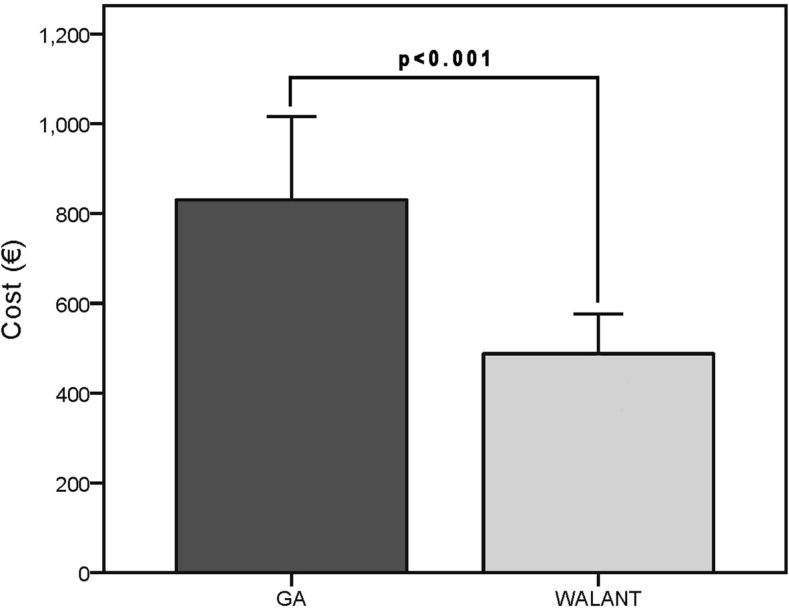
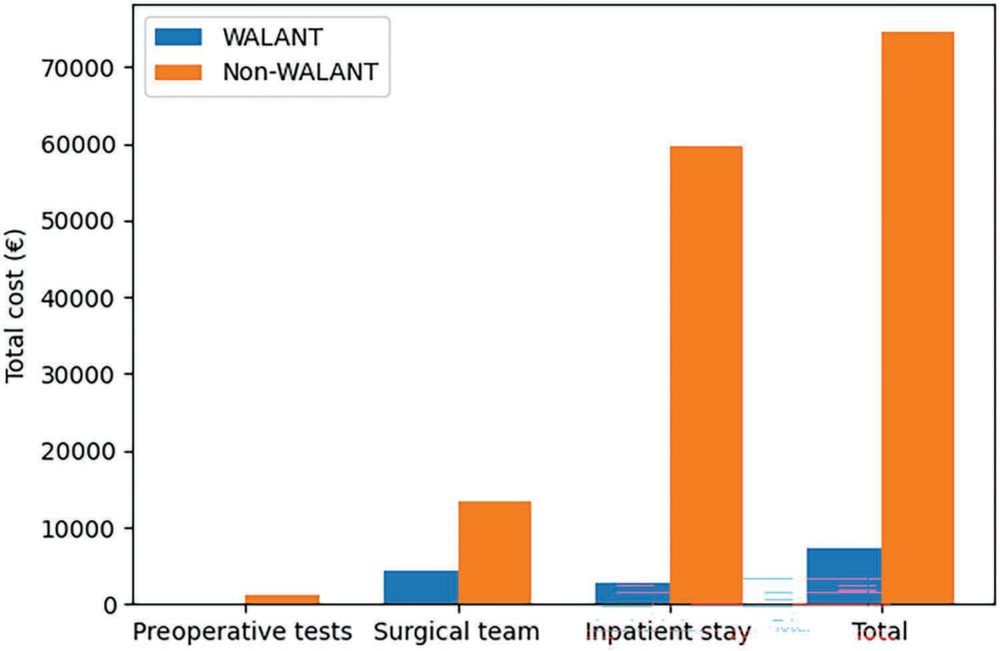
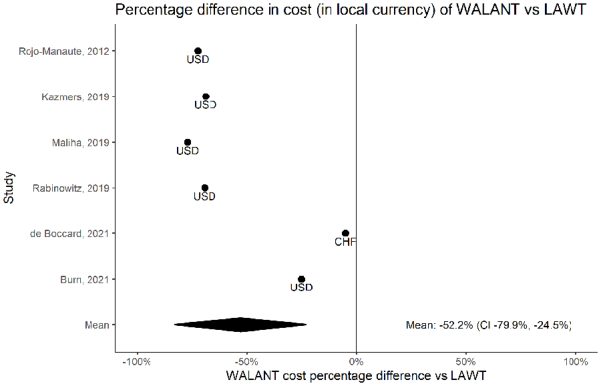
Two findings cut against the surgeon, and they belong here. In Germany, where the tariff pays a lump sum for anesthesia, day-case fracture surgery under WALANT was reimbursed 19 to 33 percent less than the same operation under a regional block, although the hospital still came out ahead because the case cost so much less to run (Trautz 2026). And in the United States, Kazmers observed that a group which shares in a facility fee has a financial reason to keep its cases in the building that charges one. Both are statements about who captures the saving, not about whether there is one. In the office there is no facility to capture it.
Safety
Field sterility, epinephrine in the finger, and what the infection rate really is.
The two objections to office surgery are sterility and what happens if something goes wrong. Both have been studied, repeatedly, in large series. The sterility demand for a carpal tunnel release is not the sterility demand for a hip replacement, and the literature is clear that field sterility is more than adequate for low-acuity surgery without implants.
Field sterility, as the Canadian multicenter study defined it: prep the hand with iodine or chlorhexidine, the equivalent of a single drape, a sterile tray with modest instruments, sterile gloves and masks, surgeons not gowned, no prophylactic antibiotics.
| Study | Setting and cases | Infection | Against the operating room |
|---|---|---|---|
| Billig 2020 | 468,365 commercial claims, minor hand procedures, 2009 to 2017: office, surgery center, hospital outpatient | 1.1 to 1.3% in all three settings | 90-day complications 2.9% office, 3.3% surgery center, 3.4% hospital outpatient; adjusted odds higher outside the office (1.24 and 1.32) |
| Kazmers 2021 | 37,602 trigger finger releases in a national claims database, 7,640 of them in the office | 0.52% office, 0.59% operating room | Major medical complications 0.99% office against 1.47%, adjusted odds 0.76; admissions 1.61% against 2.31% |
| Lawand 2024 | Meta-analysis, 79 studies, 15,595 WALANT upper-limb patients, all settings | Superficial infection the commonest event | Pooled complication rate 1.7% (0.93 to 2.7); one permanent digital ischemia, after a crush injury; fewer complications where bicarbonate was used |
| Kammien 2026 | National claims 2010 to 2022, four common operations, office matched against operating room | 0.3% in both | Same infection; fewer opioid prescriptions and emergency visits after the office |
| Zhuang 2023 | Veterans Affairs, 1999 to 2021: 2,000 procedure room, 717 operating room | 2.8% in both; 0.1% needed washout in both | Adjusted odds for the procedure room 0.84 (0.49 to 1.48) |
| Carter 2026 | 2,182 patients, one practice, office WALANT against operating room | — | Complications 2.77% office against 4.3%, with office patients older and sicker; office open carpal tunnel release 0 of 33 |
| Schindelar 2022 | 1,771 consecutive awake cases at a surgery center with one nurse and no anesthesia provider | — | No case aborted, none converted to sedation, no transfer to an emergency department |
| LeBlanc 2011 | 1,504 carpal tunnel releases, minor procedure rooms, nine Canadian surgeons, field sterility, no antibiotics | 0.4% superficial, 0 deep | — |
| Abdullah 2021 | 1,073 consecutive finger and hand operations in a minor operating room, Malaysia, diabetics included | — | No circulatory compromise; phentolamine never used |
| McKnight 2022 | 1,011 in-office cases, mostly trigger finger, no antibiotics, no monitoring | 4.3% superficial (any antibiotic prescribed), 0 deep | 99% would recommend; 7.3% after double trigger releases |
| Sandefur 2024 | 748 office open carpal tunnel releases, one institution | 8.9% if "any antibiotic prescribed", 2.3% by the CDC definition, 0.4% reoperated | Same 748 cases, three definitions |
| Far-Riera 2022 | 616 office procedures, Spanish district hospital; anticoagulants never stopped | 1 superficial in 419 carpal tunnels, 1 deep in 197 trigger fingers | No bleeding in the four patients on anticoagulants |
| Wilde 2026 | 437 office cases, minor field sterility: no ventilation, gowns or caps | 26 superficial (5.9%), 0 deep; phentolamine never used | 99.3% would repeat |
| Oakes 2022 | One surgeon's transition: 322 office alongside 216 operating room | 1.2% office against 2.8%, 0 deep in both | Office patients older, more diabetic; no implants placed in the office |
| Halvorson 2020 | Veterans Affairs: 91 procedure room, 221 operating room, carpal tunnel release | 2.2% against 3.2% | Setting not a risk factor after adjustment |
| Pistorio 2026 | 226 hands, ultrasound-guided carpal tunnel release in office rooms, seven United States sites, two years; industry-funded | 0 infections | No conversions, one complication (0.4%), return to work median four days, 95.7% satisfied at two years |
| Tessier 2025 | 174 flexor tendon repairs: 93 clinic procedure room, 81 operating room | 6.45% against 7.41%, antibiotic-prescription definition | Composite complications halved (odds 0.49); procedure room had 6 air changes an hour against 25, no difference |
| Hunziker 2025 | 153 hand and wrist fixations, plates included, outpatient theatre, no antibiotics | 3.27% | Against 3.86% in the main operating room with antibiotics; adjusted odds 1.09 |
| Milhoan 2024 | 124 endoscopic carpal tunnel releases in a standard exam room, no antibiotics, alongside 162 operating room | None in either | Pain at six weeks 2.1 against 4.1; function the same |
| Look 2020 | Veterans Affairs: 123 minor-procedure-room cases, 208 operating room | 0 against 2.4% | Complications 0 against 2.9%; turnover eight minutes shorter; the procedure rooms kept full operating-room sterility |
| Knopp 2024 | About 130 in-office procedures in a year, including finger fracture pinning | None | No major complications |
| Hedspång 2026 | 62 carpal tunnel releases in Swedish consulting rooms, ordinary clothes and a plastic apron | None | — |
Read the infection column with its definition. Counted as "any antibiotic prescribed" the rate runs 4 to 9 percent; by the CDC criteria 2 to 3 percent; by reoperation under 0.5 percent. Deep infection is 0 to 0.5 percent in every office series. The claims studies (Billig, Kazmers, Kammien) do not identify WALANT, and their office patients are healthier: Kazmers's office cohort had less diabetes (12.5 against 17.1 percent) and a quarter the smokers (2.6 against 9.9 percent).
Three things the office series say that the hospital series do not. Antibiotics add nothing: McKnight's 1,011 cases and Hunziker's 153 fixations had none, and Hunziker's infection rate without them matched the operating room's with them. Ventilation adds nothing at this level of surgery: Tessier's procedure room turned its air over six times an hour against the operating room's 25, with the same infection rate. And the patients who do worse in the office are identifiable: in Carter's 2,182 patients, smokers (23.8 against 6.1 percent) and patients with autoimmune disease (23.3 against 4.7 percent) had more complications in the office than in the operating room. Book them with that in mind.
A 2025 meta-analysis of the eleven randomized trials (794 patients) found complications no different from tourniquet-based anesthesia, with intraoperative pain reduced by more than the clinically important difference; a second, of the carpal tunnel trials alone, put the reduction at 1.6 points out of 10 with no heterogeneity between trials (Chou 2026). The American Academy of Orthopaedic Surgeons' 2024 carpal tunnel guideline states that limited evidence suggests carpal tunnel release may be safely conducted in the office setting, the studies consistently showing no increased risk of complications. Nobody has shown the office makes the operation itself any better. Nobody has shown it makes it worse.
Epinephrine in the hand
The belief that epinephrine must never go into a finger was never supported by evidence. The whole of it rests on 21 case reports, mostly before 1950, of finger ischemia after injection with procaine or cocaine plus epinephrine; both of those agents caused digital infarction on their own, and none of the 21 had phentolamine rescue attempted (Thomson 2007). The Dalhousie Project, nine surgeons in six cities, then recorded 3,110 consecutive elective injections of low-dose epinephrine (1:100,000 or weaker) into hands and fingers. There was no digital tissue loss in any case, and phentolamine rescue was never needed. A 2015 review of the emergency literature found at least 2,797 digital blocks with epinephrine, twelve of the studies randomized, and no necrosis (Ilicki 2015). Six years of Texas poison-center calls recorded 213 accidental auto-injector injections into fingers, at 1:1,000, ten times the surgical strength; every patient with follow-up recovered fully and none needed surgery (Muck 2010).
The series since say the same. In 1,073 consecutive finger and hand operations in Malaysia, diabetics included, there was no circulatory compromise and phentolamine was never used (Abdullah 2021). In 308 carpal tunnel releases done with undiluted epinephrine, about two and a half times the usual strength, there was no ischemia (Kotb 2023). In 15,595 pooled WALANT patients there was one permanent digital ischemia, after a crush injury (Lawand 2024). What epinephrine does do is measurable and minor: of 387 injections, 2.2 percent produced a brief "adrenaline rush" of palpitations and tremor and 1.8 percent a vasovagal episode (Greene 2021). Fingertip oxygen saturation can fall for a couple of minutes after injection and is normal again within half an hour (Moog 2021). At the full 7 mg/kg dose, serum lidocaine peaks at about 4 μg/mL, under the 6 μg/mL toxicity threshold (Abdullah 2023).
Epinephrine also needs time. The textbook seven to ten minutes is wrong for the skin: in a triple-blind randomized study, the lowest cutaneous hemoglobin after lidocaine with epinephrine came at 25.9 minutes. Inject, then wait 25 minutes before the incision, and the field is dry without a tourniquet.
Bupivacaine is not recommended for office surgery because of its cardiac affinity, and it adds little: after awake carpal tunnel release with or without it, patients used two or three of the thirty tablets prescribed (Diaz-Abele 2019). Keep phentolamine in the room for epinephrine reversal. In the published series you will not use it, and in the one published office-era case you would have: a 74-year-old's finger went cold and blue four hours after a Dupuytren's nodule excision and trigger release, at home, after a normal 40-minute dwell; phentolamine was not stocked and the finger was rescued with urapidil (Frey 2025). The reversal can be given hours later and still work. In a survey of surgical trainees, one in five knew that phentolamine was the reversal agent (Zargaran 2021).
What a hundred office cases look like
Put the series together and this is the shape of a year's work. Round numbers, because the definitions differ; the papers behind each are in the tables above.
| Event | Per 100 | What it looks like |
|---|---|---|
| Superficial wound infection | 1 to 5 | Counted as an antibiotic prescription. Under 1 if counted as a reoperation. Higher after two trigger fingers at once |
| Brief "adrenaline rush" | 2 | Palpitations and tremor for a few minutes after injection; reassurance (Greene 2021) |
| Vasovagal episode | 2 | Why the patient is supine and the smelling salts are in the drawer (Greene 2021) |
| Pale fingertip after injection | a few | Saturation dips for two minutes and is normal within half an hour (Moog 2021) |
| Needs a tourniquet for bleeding | 0 to 2 | If you waited 25 minutes. One in five if you did not (Gabay 2025) |
| Converted to sedation | 0 | 0 of 226 and 0 of 1,771 in the office and surgery-center series; the conversions in the literature are hospital fracture and nerve cases |
| Deep infection | 0 to 0.5 | None in most office series; one in 197 trigger fingers in the Spanish series |
| Digital ischemia | 1 in 15,000 | One permanent case in 15,595 pooled patients, after a crush injury (Lawand 2024). Reversible with phentolamine, even hours later |
| Local anesthetic toxicity | none reported | Serum lidocaine at the full 7 mg/kg dose peaks at 4 μg/mL against a 6 μg/mL threshold (Abdullah 2023) |
| Transfer to hospital | 0 | None in 1,771 surgery-center cases or any office series read |
What to keep for the day you need it
- Smelling salts. Vasovagal episodes are the commonest event in awake surgery, about one in fifty injections, which is why the supine position is preferred.
- Phentolamine, 1 mg in 1 mL, to infiltrate where the local went, repeated if the color does not return. Everybody in the room knows where it is. Every patient leaves knowing that a finger that goes white or blue at home is a phone call, not a wait-and-see.
- An automated external defibrillator (AED), and current basic life support (BLS) training for the surgeon and the team.
- A formal consent, a formal timeout before every case, and a formal operative report the same day. Not being in a hospital is no reason to drop any of them.
The patient is awake, unsedated and has eaten breakfast. There is no airway, no anesthetic clearance, no fasting and no pre-operative labs. Blood pressure at injection moves by about 4 mmHg, against a 20 mmHg fall at induction of general anesthesia (Liu 2022). Most of the physiological risk of a surgical episode is removed before the patient sits down.
Method
The office guidelines, the technique behind them, and one afternoon's routine.
WALANT is Don Lalonde's technique, and he is the father of it. Everything on this page builds on his work (Lalonde 2017). My guidelines paper with colleagues at Michigan State on field sterility in the office (Schank 2023) and my hand-trauma chapter (Clarkson and Park) lean heavily on what he worked out. His injection drawings are below (Joukhadar 2021). The literature page gives the numbers behind each step.
The principles
The local anesthetic
Every injectable local anesthetic descends from cocaine and is an ester or an amide. The esters (cocaine, procaine, tetracaine) are broken down by pseudocholinesterase to para-aminobenzoic acid, a known stimulus for hypersensitivity. The amides (lidocaine, bupivacaine, prilocaine, ropivacaine, levobupivacaine) came in the 1940s, work faster, and carry a much lower allergy risk; the rare reactions they do cause are usually attributable to the preservative methylparaben, which can break down to the same acid, so a patient allergic to esters gets a preservative-free amide. True anaphylaxis to lidocaine is extremely rare against an estimated two billion injections since 1948. A rule of thumb from the chapter: an amide has two letter i's in its name. The trap is the trade name Marcaine, which is bupivacaine and an amide. Caution is advised when amides are used alongside macrolides such as erythromycin, HIV protease inhibitors, azole antifungals such as itraconazole, and verapamil.
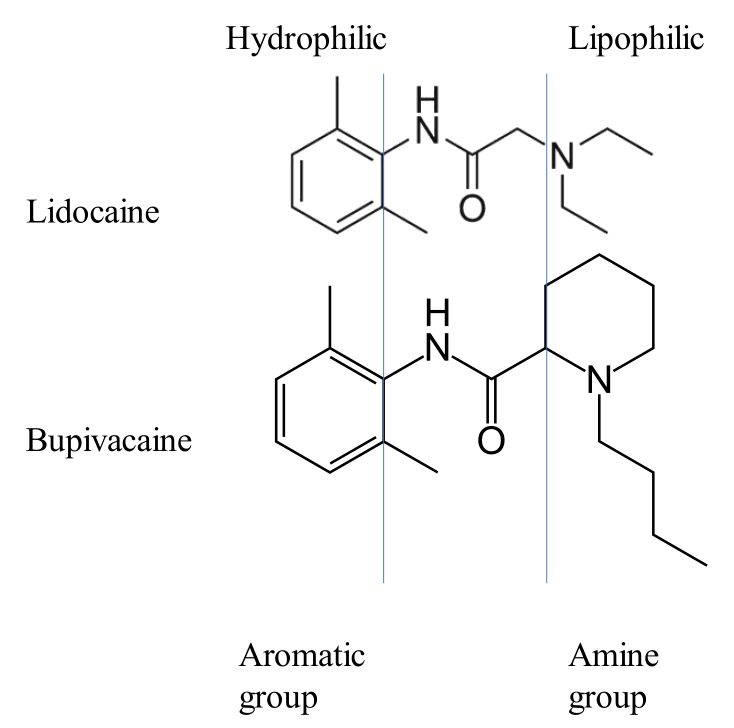
The two amides hand surgeons use are lidocaine, swift in onset and shorter in duration, and bupivacaine, slower to take effect, longer lasting and more cardiotoxic. Bupivacaine gives up to eight hours of anesthesia to pain, and numbness to touch and pressure for twice that, which is why many physicians consider it less suitable for office use; its myocardial affinity can cause fibrillation before any central nervous system warning appears. I don't use it in the office, and most WALANT surgeons don't either. Lidocaine works by blocking voltage-sensitive sodium channels; it must be water-soluble to travel through the tissue and lipophilic to cross the myelin, so each molecule has a hydrophilic amine end and a lipophilic aromatic ring. Infected, inflamed tissue defeats it twice over: the acid environment ionizes a weak base so that it cannot cross the axon membrane, and the hyperemia washes it away. Inject proximal to and around inflamed tissue, not into it.
Dose
The classical safe dose of lidocaine is 4 mg/kg without epinephrine and 7 mg/kg with it. Each milliliter of 1% lidocaine holds 10 mg, so a 70 kg adult can take about 50 mL of 1% lidocaine with epinephrine. That ceiling comes from conservative estimates made in the 1950s; tumescent liposuction has since used up to 28 mg/kg (Klein 2016, cited in Schank 2023), which assumes third-space sequestration and the removal of part of the solution by suction. I don't go above 7 mg/kg in the office. Away from a hospital, toxicity can't be managed as well. For a bigger field, dilute rather than exceed it: 1% lidocaine with 1:100,000 epinephrine and bicarbonate can be made up to 200 mL with saline and still works, for a shorter time. Bupivacaine is 2 to 3 mg/kg with or without epinephrine, because its action outlasts the epinephrine. Injection site, pregnancy, epinephrine, and cardiac, renal or hepatic disease matter more to the plasma level than body weight does.
| Agent | Safe dose in the office | Maximum plasma concentration |
|---|---|---|
| Lidocaine | 4 mg/kg; 7 mg/kg with epinephrine | 5 μg/mL |
| Bupivacaine | 3 mg/kg; no increase with epinephrine. Not encouraged in the office | 1.5 μg/mL |
Schank 2023, tables 2 and 3. At the full 7 mg/kg dose, measured serum lidocaine peaked at about 4 μg/mL in distal radius plating (Abdullah 2023).
Toxicity, and what to do about it
Lidocaine toxicity announces itself: perioral numbness, facial tingling and a metallic taste. At higher doses it progresses to tonic-clonic seizures, then ventricular fibrillation and cardiac arrest. Bupivacaine can produce ventricular arrhythmia heralded by a prolonged PR interval and a widening QRS. In a cardiac arrest or seizure the advanced cardiovascular life support protocol is followed, with prompt airway management, intravenous fluid and defibrillation; vasopressors may be needed to support coronary perfusion; amiodarone is chosen over lidocaine for arrhythmia; seizures are managed with benzodiazepines; and electromechanical dissociation may be rescued with lipid emulsion, which extracts the lipophilic drug from the myocardium. None of this has been needed in any office series read for this site, which is the reason to know it rather than a reason not to.
Bicarbonate, and warmth
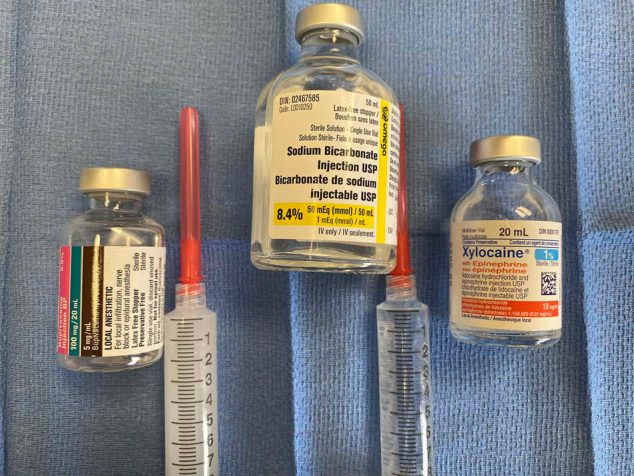
Local anesthetics are mildly acidic, pH 3.3 to 5.5, and the acidity is part of the sting. A Cochrane review of 23 randomized trials found buffered lidocaine less painful to inject by one to two points out of 10, and preferred by patients three to one (Cepeda 2010; the review was later withdrawn under Cochrane's sponsorship policy, not over its findings), and the WALANT trials since agree: injection pain 2.2 out of 10 buffered against 5.8 plain (Kang 2019), and fewer complications in the buffered studies when pooled (Lawand 2024). The mixture in both publications is 9 mL of 1% lidocaine with 1:100,000 epinephrine and 1 mL of 8.4% sodium bicarbonate, which brings it to about pH 7.3; 2% lidocaine needs only 0.5 to 0.6 mL per 10 mL, and bupivacaine and ropivacaine must never be buffered, because they precipitate (AlShammari 2025). Warm the refrigerated solution before you draw it up. A buffered syringe keeps for two weeks; the 1:200,000 premix sold in Europe works, but gives a less dry field (Amin 2020).
Epinephrine
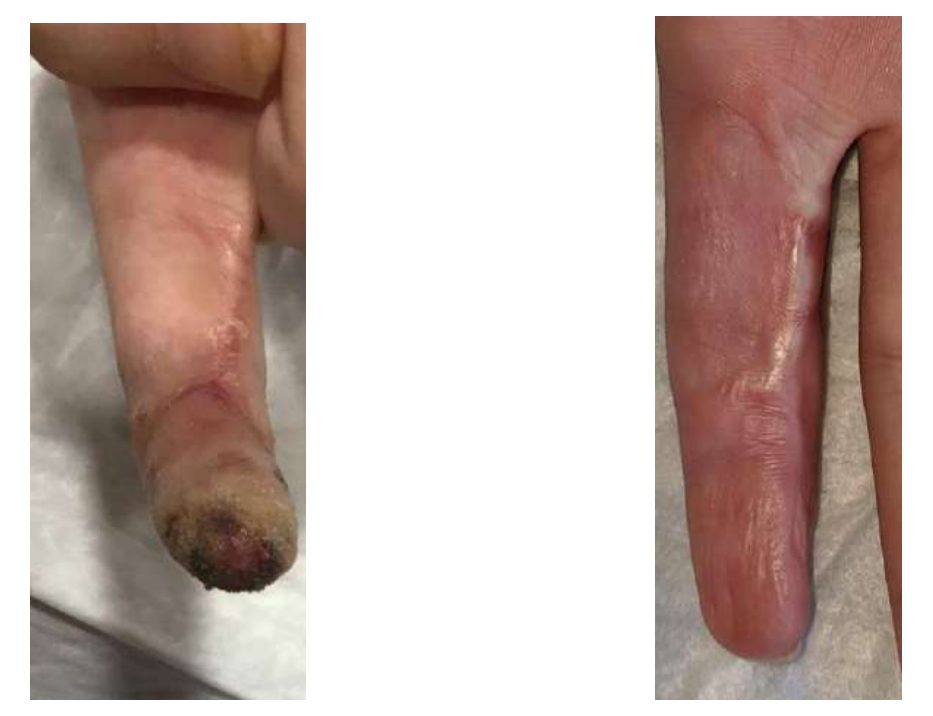
Twentieth-century dogma held that epinephrine was forbidden in the finger because of the risk of thrombosis of the digital vessels. The dogma was built on case reports of fingers injected with procaine or cocaine, agents that caused infarction on their own; the evidence is on the safety page. In Sterling Bunnell's phrase, a jeweler cannot repair a watch in a pool of ink, and hand surgery has always wanted a bloodless field. Putting epinephrine back into the hand is what let the tourniquet go, and the tourniquet was the reason awake surgery hurt. I have counted the papers that established its safety, and the ischemic events reported since 2012: six case reports. Vascular observation is still required. I have seen one case myself, a fingertip that necrosed after epinephrine in a finger crushed seven weeks earlier, salvaged with hyperbaric oxygen (Engwall 2021).
| A previous crush injury with scarring |
| Scleroderma |
| Vasculitis |
| Raynaud's phenomenon |
| Unstable coronary heart disease, in the office setting |
| Severe peripheral vascular disease |
Two more cautions. Patients with severe cardiovascular disease may be better served by a reduced dose and a monitored setting, although there are series reporting safe use; and, on animal evidence, caution is advised for patients taking tricyclic antidepressants or serotonin-norepinephrine reuptake inhibitors. One warning is sharper than the chapter's table, and it comes from this site's author's own practice: a patient whose coronary artery disease is not controlled, who still gets breakthrough angina, should not be given epinephrine at all. He has induced angina with it, infiltrating 1% lidocaine with 1:200,000 epinephrine at 7 mg/kg beneath a calciphylaxis eschar on a medial thigh — a large field, a full dose, and a patient whose heart had no margin. Personal communication, Clarkson 2026. Warn every patient that they may sense the drug: fearfulness, shaking and palpitations, a brief "adrenaline rush" that frightens only the patient who was not told. It happened after 2.2 percent of 387 injections, and a vasovagal episode after 1.8 percent (Greene 2021). The chapter injects with the patient sitting up and lies them flat, legs raised, the moment they report nausea or faintness; most WALANT surgeons inject supine from the start.
Phentolamine reverses epinephrine. Inject 1 mg in 1 mL into the site where the local went, and repeat if the color does not return; the one time I have used it, after a vessel was found injured during a tendon repair in the main operating room, the white fingertip pinked up twenty minutes later. Dusky or blanched fingertips at the end of a case are a common early finding, and the surgeon does not discharge the patient until perfusion improves. Every patient leaves knowing that a finger that goes white or blue at home is a phone call, not a wait-and-see.
The injection
The equipment is a 10 mL syringe (which holds 11), a 27- or 30-gauge needle, 9 mL of 1% lidocaine with 1:100,000 epinephrine buffered with 1 mL of 8.4% bicarbonate, and phentolamine within reach. Delivery through a 3 mL syringe can help with the first, slow part. The sequence, from the guidelines' table of technique:
- Warm the refrigerated solution.
- Count down verbally from three. The patient takes a deep breath at two.
- Pinch the skin at the moment of injection and keep pinching until the needle pain has gone.
- Inject slowly with a stable needle, held in two hands, the thumb already on the plunger.
- With the needle at 90 degrees to the skin, raise a bleb of 0.5 to 1 mL, then rub the tumescence for 30 seconds.
- Inject the rest over 60 seconds with the needle at a more tangential angle, keeping the tip within the swelling you have already made, and work outward, slowly.
- It is reasonable to inject more than you think you need.
- Wait 20 to 30 minutes, and do not rush.
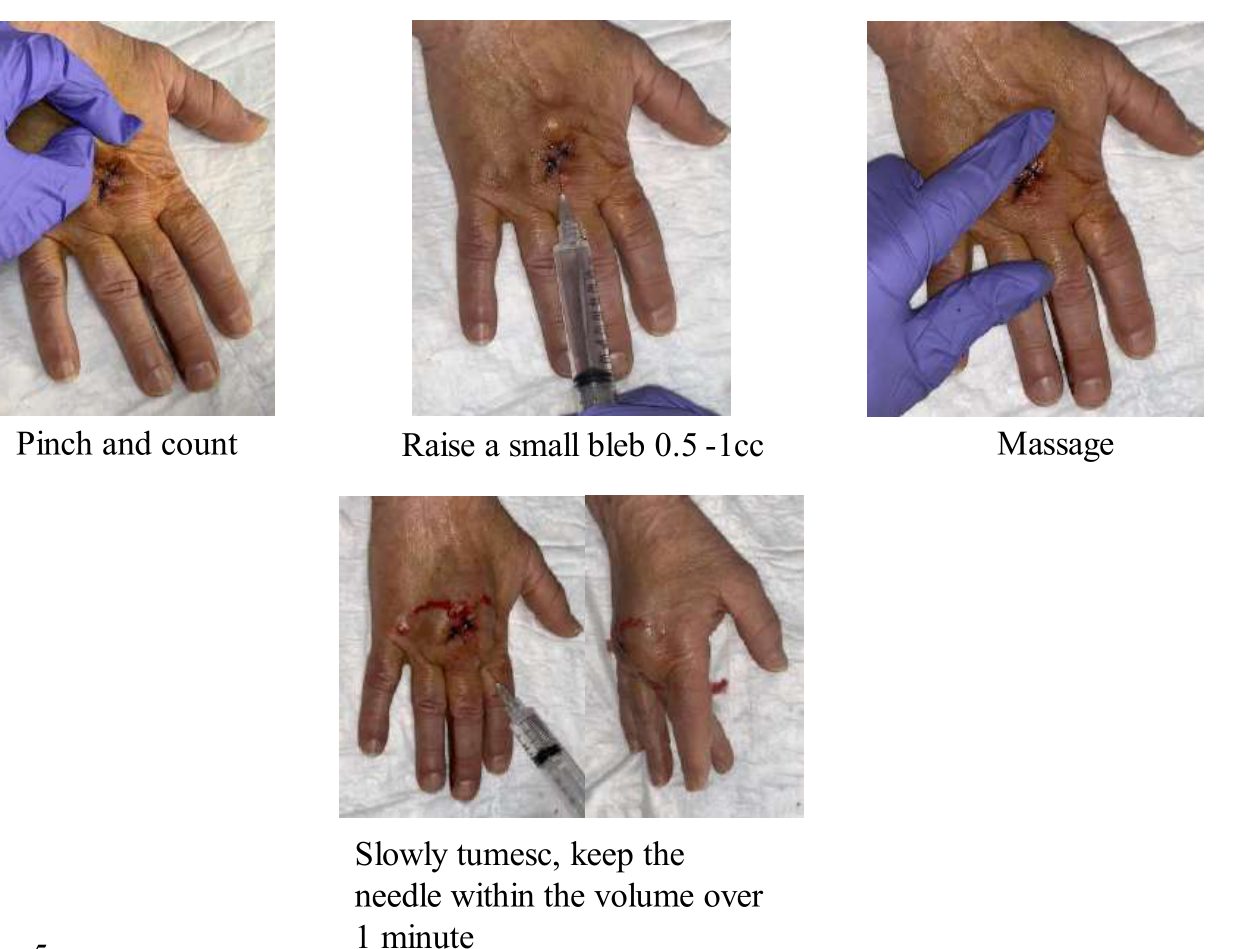
Lalonde's thirteen rules for a painless injection, drawn by his group, say the same thing in pictures. Buffer the local and use a 27- or 30-gauge needle. Pinch the skin up into the needle rather than pushing the needle down into the skin, and pinch just proximal to the entry so that the sensory noise arrives first. Go in perpendicular, which irritates fewer nerve fibers than an angled entry. Do not inject into the dermis; put at least 2 mL slowly into the fat just beneath it before the needle moves at all. Never advance a sharp tip into tissue that is not yet numb: keep a centimeter or two of visible, palpable swelling ahead of it, and re-enter only through skin that is already white. Work from proximal to distal relative to the nerves. Use a blunt cannula for large areas. Ask the patient to tell you every time they feel anything, and score yourself. Done this way, 85 to 90 percent of patients feel nothing after the first poke (Billard 2025); the three surgeons who scored themselves on 154 patients found that 61 felt nothing at all and only one felt pain more than once (Brutus 2025).
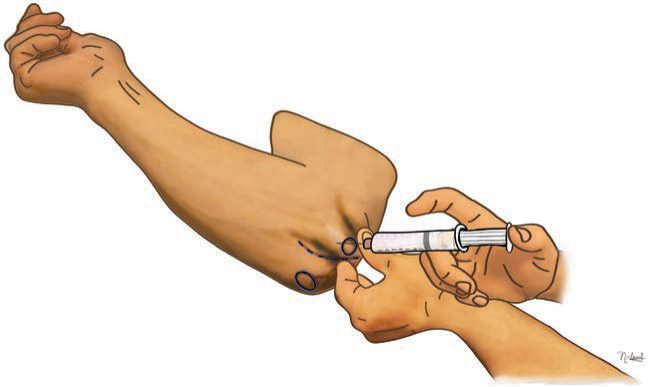
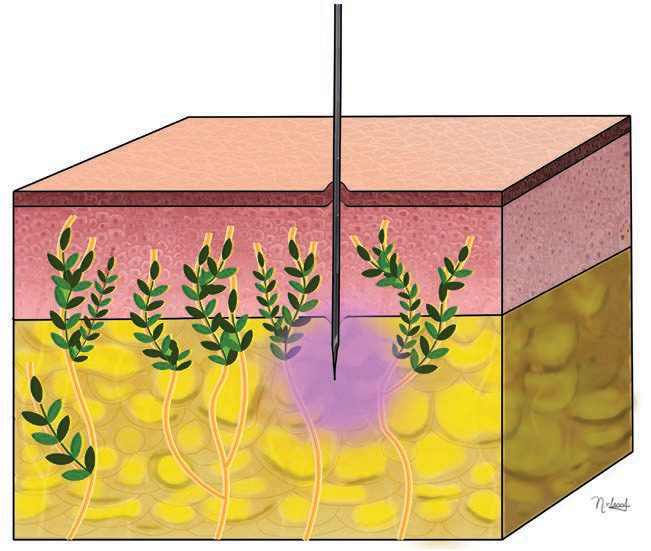
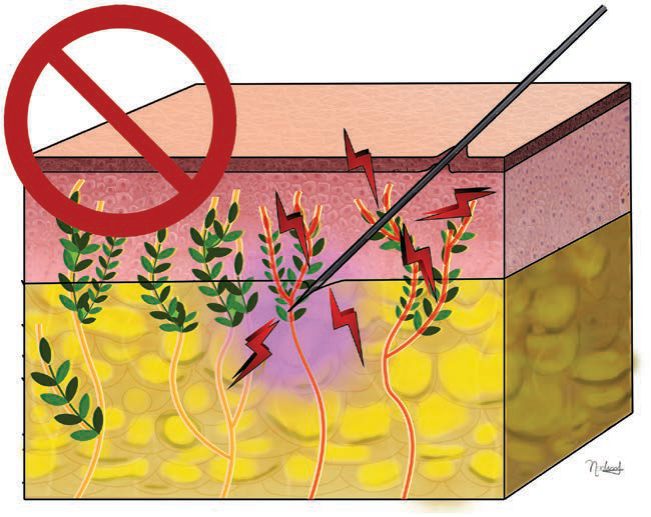
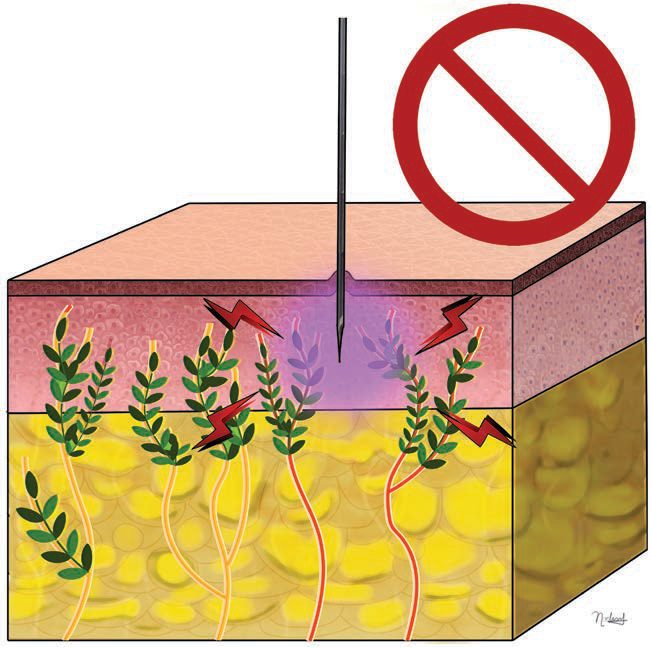
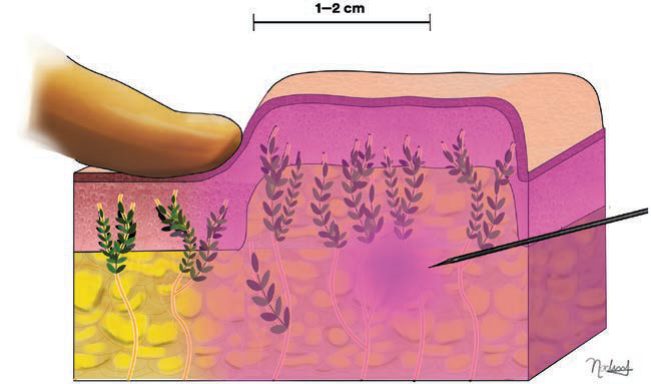
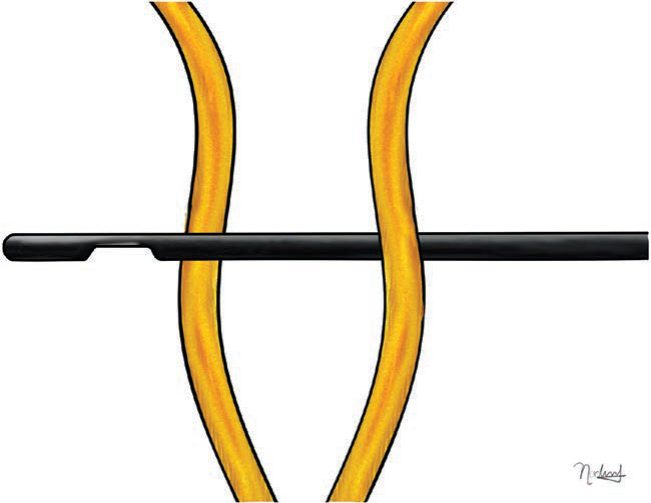
Drawings from Joukhadar and Lalonde 2021, Plast Reconstr Surg Glob Open, figures 3, 5, 6, 7, 10 and 12, reproduced under the journal's CC BY-NC-ND 4.0 license. Two of that paper's figures are themselves reproduced from an earlier journal and are not shown here.
How much to use. One percent lidocaine is the concentration in 49 of the 60 studies that state one (Lawand 2024). Volumes run from 3 mL for a trigger finger to 40 mL for a cubital tunnel, and the series are consistent:
| Trigger finger | 3 to 4 mL |
| Open carpal tunnel release | 10 to 20 mL |
| Endoscopic carpal tunnel release | 20 mL: 7 forearm, 3 at the incision, 10 in the tunnel (Milhoan 2024) |
| Ganglion excision | about 11 mL (Shou Wai 2022) |
| De Quervain's release, lacertus release | 10 to 20 mL |
| Dupuytren's fasciectomy | 15 to 40 mL in the palm plus 2 mL per phalanx, dorsal too if the web is opened (Barone 2024) |
| Cubital tunnel release | 40 mL |
| Basal joint arthroplasty | 45 to 65 mL at 0.5% (Castelo 2023) |
| Distal radius plating | 40 to 50 mL at 0.5%, around the periosteum as well as the incision |
| Forearm, tendon transfer, large flap | 100 to 200 mL at 0.25% with 1:400,000; up to 210 minutes of surgery on 180 mL in one report |
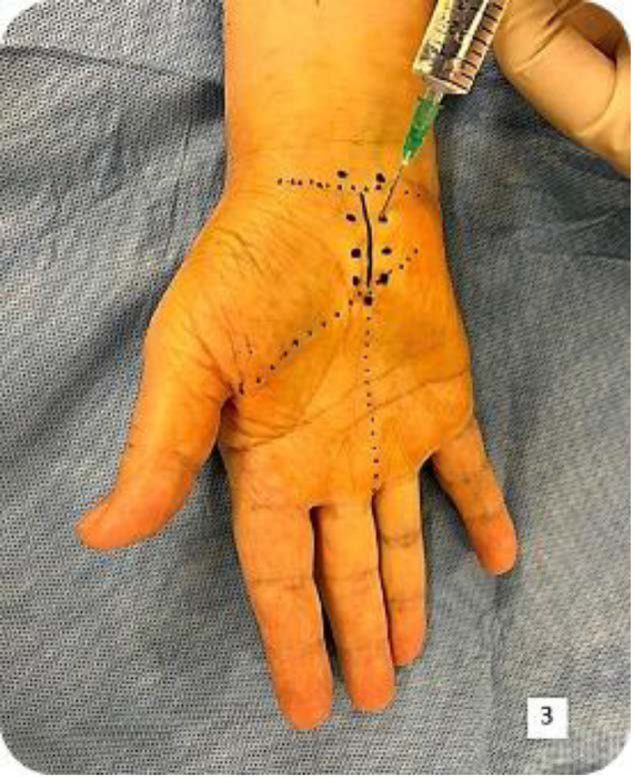
The exceptions and the special cases
The finger. The digital block is the exception to the tumescent rule. Put no more than 2 to 3 mL of the buffered mixture between the digital bundles, with the needle at 90 degrees, so that the vessels are not compressed by the volume. For dorsal anesthesia proximal to the proximal interphalangeal joint, add a dorsal injection of 3 mL. A local ring tourniquet is well tolerated if you want one.
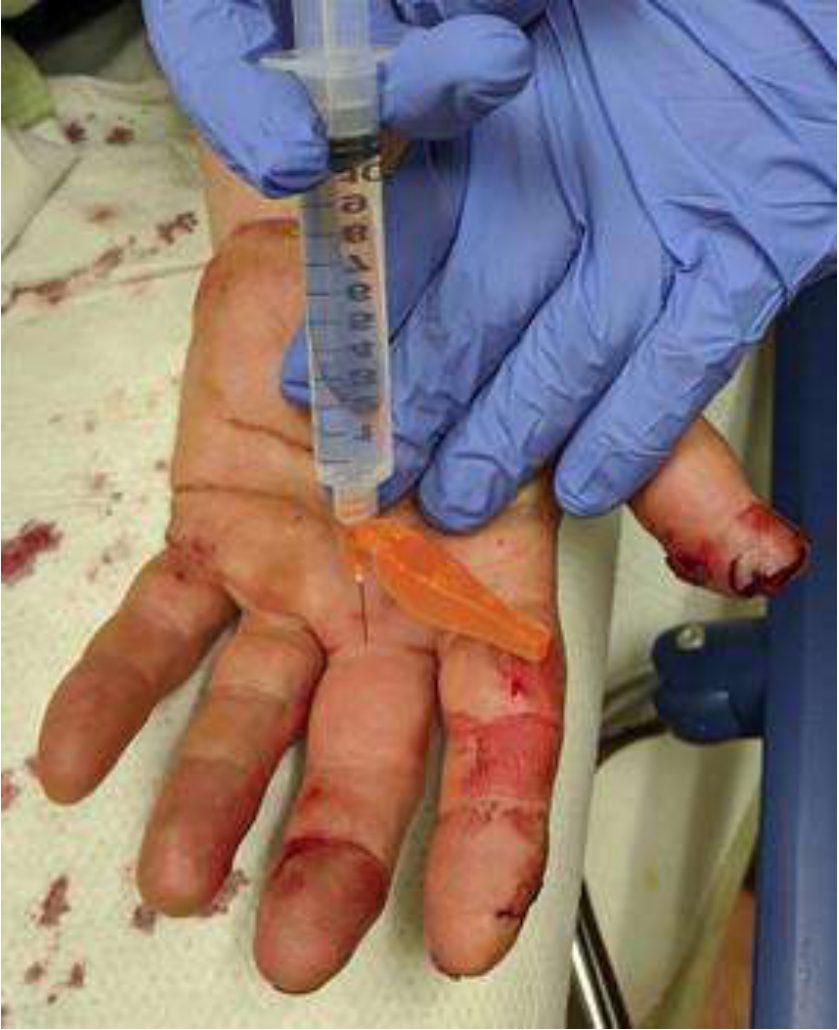
The forearm and other large fields. Dilute 50 mL of the buffered 1% mixture up to 200 mL with saline; it keeps acceptable efficacy for a shorter time. Tumesce the entry point with a 27-gauge needle, then fill the region through a blunt cannula. Expect a zone of vasoconstriction inside the tumesced area and more bleeding beyond it, where the nerves are blocked but the epinephrine never reached.
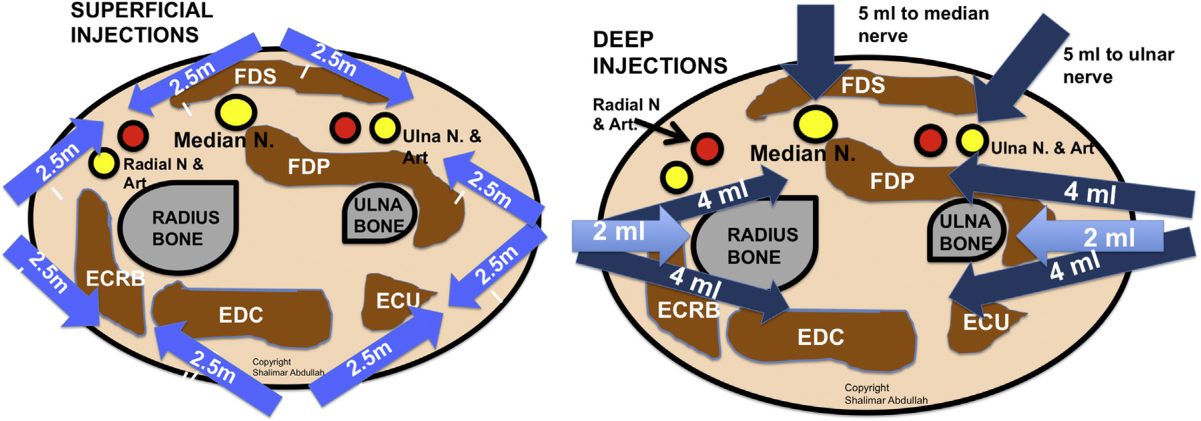
Paradoxical bleeding. Vasoconstriction happens only where the epinephrine sits in the interstitium around the capillary bed. A proximal injection paralyzes the sympathetic fibers to the digital vessels, so a finger beyond the tumesced zone can bleed more, not less, despite the epinephrine upstream. Densely fibrotic tissue does the same, because the drug cannot perfuse it; the stiff hand at tenolysis is the classic example. The answer is to tumesce the field you are cutting, not the field you are blocking.
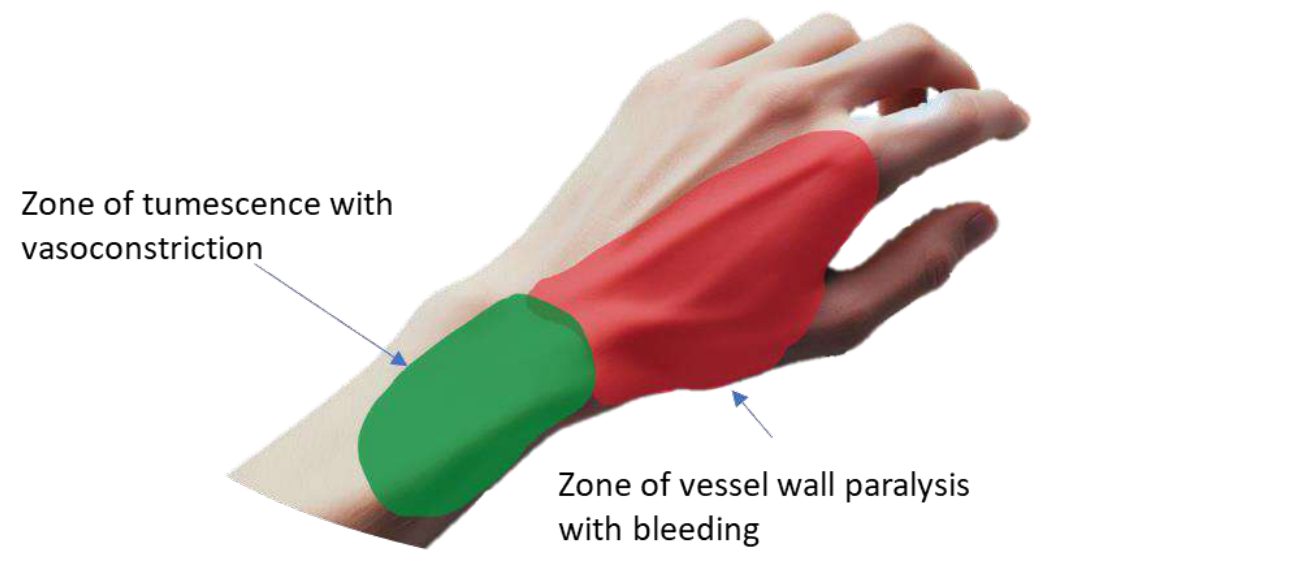
Metacarpal fractures and K-wires. Tumesce around the fractured metacarpal and the planned wire entry points, dorsal and volar, and make sure the metacarpals on either side are inside the tumesced zone, so the wire is not felt as it drives into the adjacent bone.
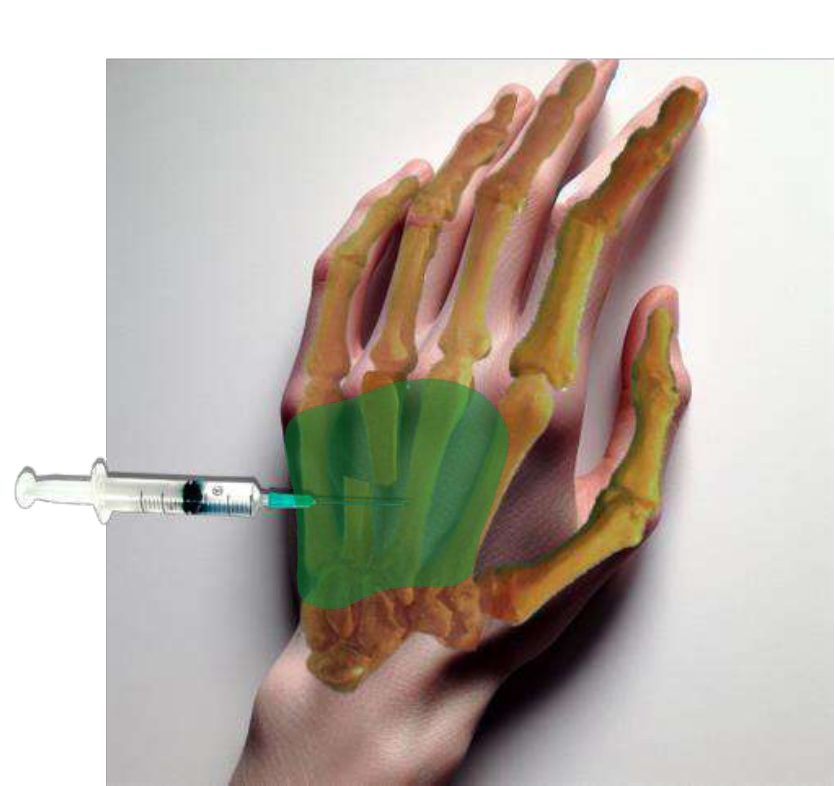
Infection. Inflamed tissue ionizes lidocaine and washes it away; tumesce proximal to and around the inflamed area rather than into it. The wait. The textbook seven to ten minutes is wrong for the skin: the lowest cutaneous blood flow after lidocaine with epinephrine comes at about 26 minutes (McKee 2013, cited in Schank 2023), and the series that did not wait paid for it. One teaching hospital needed a tourniquet for hemostasis in 90 of 416 cases (Gabay 2025), and the single study arguing that seven minutes is enough, 17 patients per arm, put all three of its complications in the seven-minute arm (Hernandez 2020). The alternative, local with an arm tourniquet, doubles the discomfort for the same operative time: 3.6 against 1.7 out of 10 in a randomized trial (Saleh 2021). The objection that a ten-minute release does not justify a half-hour wait has an answer: batch.
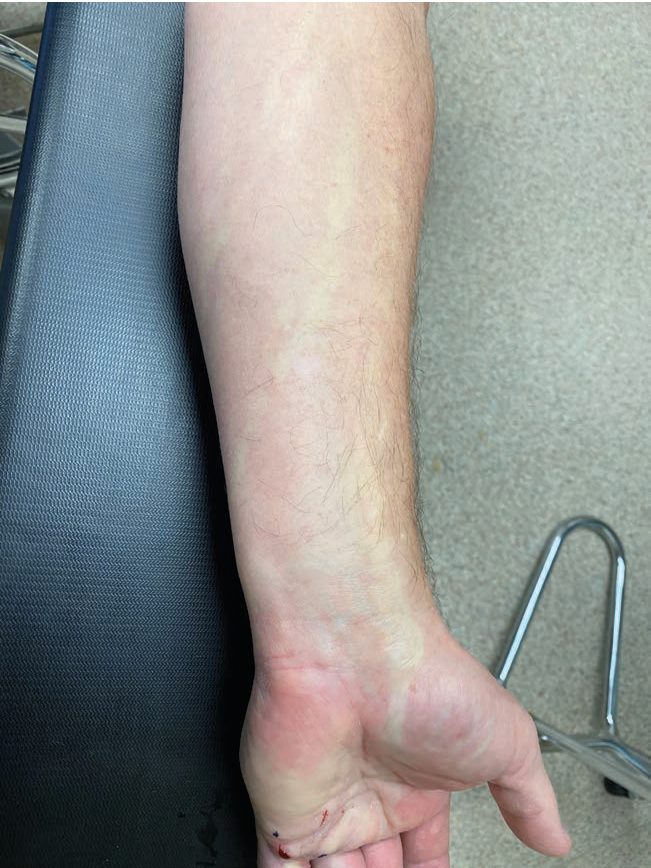
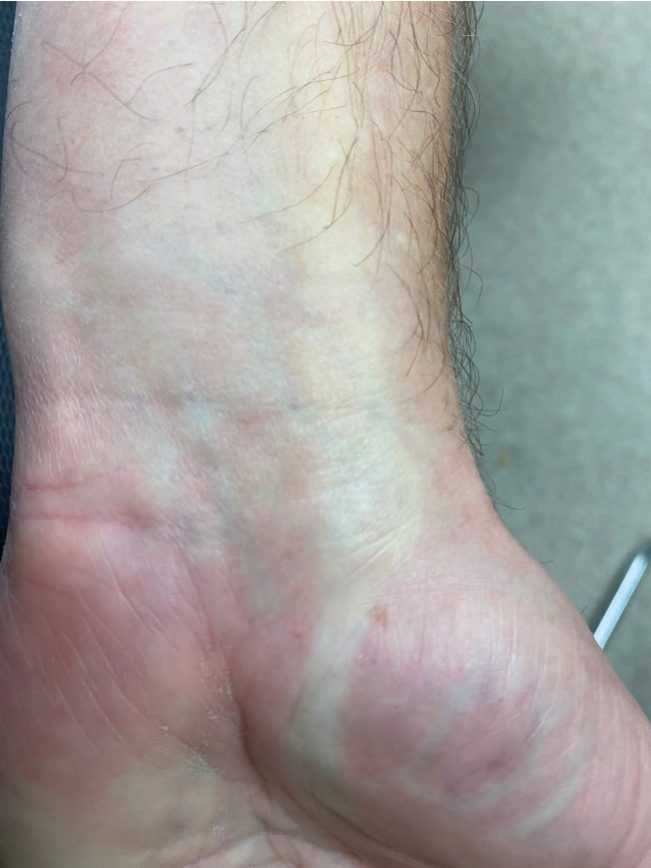
One afternoon's routine
My routine for a list: bring the first two or three patients in together, thirty minutes before the start. By the time the second and third have been injected it is time to start the first, and the surgeon stays one or two patients ahead all afternoon, with later patients arriving for their block between cases. In my practice a midlevel provider or a qualified resident gives the blocks in two clinic rooms separate from the procedure room, and the surgeon moves on to the next case while a midlevel or resident closes and dresses. One medical assistant circulates; the surgeon may scrub alone.
Consent and timeout
Procedure-specific consent signed before the patient enters the room. A formal timeout in the room, as in any operating room: patient, procedure, side, allergies.
Inject, two or three patients ahead
The block in a clinic room, by the surgeon, a midlevel or a resident, as described above. Most WALANT surgeons inject with the patient lying supine. It is what most patients expect, and it protects against fainting. Then the patient waits in a lounge or in the chair, with the headset on if they want it, while the local does its work.
Prep and drape
The patient washes with soap and water or chlorhexidine; the team paints with chlorhexidine or iodine once the patient is positioned. A drape on the table and, if you like, a towel over the forearm. The patient holds up their own limb for prepping, so no extra pair of hands is needed. Sterile gloves. Gown, mask and hair cover are surgeon's preference and personal protection, not infection control; sterile sleeves let you rest a forearm on the field for longer cases.
Operate
Most surgeons operate with the patient supine. It is familiar, comfortable, and protects against fainting and falls. Cautery is rarely needed with epinephrine on board (2 of 22 ganglion excisions against 13 of 20 under general anesthesia with a tourniquet; Shou Wai 2022); a battery thermal pen opened case by case covers the exception. Talk to the patient. Then use them: have them make a fist before you close a tendon repair, which found a gap, a trigger or a rupture to fix on the table in 10 of 41 repairs (Elhameed 2023); watch the finger run through a released pulley; set a transfer's tension with the patient firing it; check that a K-wire does not block early motion. Past ninety minutes, expect to top up the local, and have a sterile tourniquet in the room for the occasional case that bleeds anyway, 5 of 148 in one series (Takagi 2022).
Dress, instruct, document
Dressing and splint in the chair. Post-operative instructions given while the patient is calm and attentive, in the chair, not on a discharge sheet. Send them home on acetaminophen and an anti-inflammatory: an office series that prescribed no opioids at all found 2.8 percent asked for anything stronger by the next day and 5.6 percent within the week (Sraj 2019), and in national claims the office cuts the opioid prescriptions filled after trigger finger release from 51 to 34 percent (Kammien 2026). The operative report is its own encounter in the record, written as it would be for a hospital case, and, because there are no nursing notes, it records the prep, the drape, the local and its volume, and any other drug given. The signed consent is uploaded with it. All of it the same day.
Check the fingertips, then phone them the next day
Nobody leaves with a dusky fingertip. The office patient then goes home within the hour, not after a recovery-room check. One series that discharged carpal tunnel patients immediately had unscheduled visits in 13.8 percent, against 4.5 percent after a Bier block with a recovery-room stay (Lech 2021). A call the next morning, two minutes each, is cheaper than the visit, and is how the finger that goes white at home gets reported.
Antibiotic prophylaxis is not needed for hand surgery without an implant, and the evidence is now good that it adds nothing even with one: 153 hand and wrist fixations done without antibiotics in an outpatient theatre had the same infection rate as the main operating room's with them (Hunziker 2025), and the two largest office series gave none. Where a cephalosporin is wanted, the oral route gives 90 percent of the bioavailability of the intravenous one.
The room runs on three people. Lalonde's unit does three carpal tunnel releases an hour with one surgeon, one nurse and one receptionist (Degreef 2024); a Calgary minor-procedure day gets through 10 to 15 cases against three or four in the main operating room (Ponich 2025); a surgery center ran 1,771 consecutive awake cases with one nurse monitoring and circulating and no anesthesia provider, without a single abort, conversion or transfer (Schindelar 2022). What the room, the tray and the staff need is on the setting-up page. Which operations belong in the office, and which still belong in the operating room, is on the page on what can move.
The awake patient is also a captive, attentive one, and the fear they bring in with them is treatable in the chair. Virtual reality, headphones and music, and a screen are covered on the patient experience page.
What can move
Almost everything has been done awake somewhere. Less has been done in an office. The table separates the two.
The literature on awake surgery runs from trigger finger to shoulder disarticulation. For a surgeon deciding what to move out of the operating room, the question is narrower: what has been done in an office or minor procedure room, in numbers, with the infection and conversion rates reported. That is the first group below. The second group has been done awake in hospitals, often with an anesthesiologist on standby or an overnight bed, and belongs there until someone shows otherwise.
| Operation | Largest series | Where | Conversions | What happened | Refs |
|---|---|---|---|---|---|
| Office and minor procedure room, in numbers | |||||
| Trigger finger release | Kazmers 2021: 7,640 office claims; McKnight 2022: 713 office | Office | — | Kazmers (claims): major medical complications 0.99% against 1.47% in the operating room (adjusted OR 0.76), but surgical site complications not different (0.67% against 0.88%). The office cohort was healthier, so part of the signal is selection. McKnight: 4.6% superficial infection, 7.3% for two fingers, 0 deep | 56, 45 |
| Open carpal tunnel release | LeBlanc 2011: 1,504; Far-Riera 2022: 419 (retrospective) | Minor procedure room, office | None reported | 0.4% superficial, 0 deep (LeBlanc). Far-Riera: 10.2% complications, mostly pillar pain (23 of 419), one superficial infection, reoperation 1.5% | 43, 21 |
| Ultrasound-guided carpal tunnel release | Marwin 2026: 1,082 hands at 22 US sites, 29.8% in offices; Pistorio 2026 (ROBUST): 149 patients, 226 hands, 7 sites, all office | Office (ROBUST); office and surgery centre (Marwin) | 0 of 226 (ROBUST) | ROBUST: 0 infections, one complication (0.4% per hand) over two years, return to work median 4 days. Marwin: 0 serious adverse events, one superficial infection in 1,082, reoperation 0.1%. Both are device-linked (Sonex) and device-specific | 112, 59 |
| Endoscopic carpal tunnel release | Milhoan 2024: 124 | Standard exam room, no antibiotics | — | No infections; less pain at six weeks than the operating-room cohort | 62 |
| Mass and ganglion excision, de Quervain's, mucous cyst, nail bed, foreign body, wire removal | McKnight 2022: 158 masses, 18 de Quervain's and the rest | Office | — | 1.9% superficial infection after mass excision, 0 deep | 45 |
| Cubital tunnel release, lacertus release | Brutus 2025: 13 cubital and 50 lacertus; Ahmad 2023: 93 lacertus | Outpatient hand centers, day care | Brutus: one top-up, in the radial tunnel series | Brutus: no complications reported. Ahmad: 86% would choose it again | 86, 125 |
| Dupuytren's fasciectomy | Brutus 2025: 10; McKnight 2022: 6 | Outpatient center, office | One top-up | No complications reported; the office series are small | 86, 45 |
| Hand and finger fracture fixation in children: K-wire pinning | Shulkin 2026: 75 children pinned in a minor procedure room | Minor procedure room | 0 of 75 | No infections without antibiotics; pain 2.2 out of 10; 25-minute cases | 123 |
| Flexor tendon repair | Tessier 2025: 93 in a clinic procedure room (vs 81 in the operating room) | Clinic procedure room | — | Infection 6.45% against 7.41% in the operating room; composite complications halved (OR 0.49), but procedure-room cases were simpler and waited less (median 117 against 613 minutes). Awake testing found a gap, trigger or rupture to fix in 10 of 41 repairs in a separate series (Elhameed 2023) | 60, 128 |
| Local and regional flaps | Connors 2023: 21, reverse radial forearm included; Seretis 2023: 49 flaps and grafts | Connors: setting not verified; Seretis: university hospital theatre | 0 (Connors); 0 flap loss (Seretis) | Connors: 0 complications, 0 opioids. Seretis: 3 of 49 complications (2 infections, 1 dehiscence); theatre time 61 against 79 minutes | 116, 115 |
| Rheumatoid soft-tissue surgery: wrist synovectomy with retinacular transposition, extensor hood centralization | Heritage Hand and Plastic Surgery office series | Office | — | A frail population that tolerates the office better than the operating room; the dynamic reconstruction is checked with the patient moving. Personal communication, Clarkson 2026 | 7 |
| Extensor tendon transfers | Heritage Hand and Plastic Surgery office series; awake transfers published from hospitals: Ahangar 2025 (40), Abdullah 2020, Fahandezh-Saddi Diaz 2022 (210 minutes on 180 mL) | Office (Heritage); hospital in the published series | None reported | The awake patient fires the transfer and the surgeon sets the tension on it; 65% completely satisfied awake against 35% under general anesthesia (Ahangar 2025). Personal communication, Clarkson 2026 | 7, 135, 136, 131 |
| Done awake, in hospital, with an anesthesiologist near | |||||
| Hand and wrist osteosynthesis: wires, screws, plates | Hunziker 2025: 153 hands in a grade 1 outpatient operating theatre, no prophylactic antibiotics, against 389 in the main operating theatre with antibiotics | Grade 1 outpatient theatre, comparable to the main room | NR | Infection 3.27% without antibiotics against 3.86% with them in the main theatre (IPTW OR 1.09). This is evidence about antibiotic prophylaxis in a sterile theatre, not evidence that a procedure room is safe. | 61 |
| Distal radius plating | Tu 2022 meta-analysis: 128 awake against 135 under general | Operating room | 1 to 4% in the series | Complications 0.8% against 5.9%; a day less in hospital. A second review of 226 awake plated wrists found no adverse events and 1.3% conversions, and still concluded it is not yet a procedure-room operation (Gouveia 2022) | 114, 124 |
| Forearm diaphyseal plating | How 2022: 61 patients, 76 bones | Operating room, overnight | 0 of 61; 11 needed more local | No infection at six months; 92% would recommend; blood pressure rose after injection | 121 |
| Thumb basal joint arthroplasty | Castelo 2023: 16 | Hospital | 1 of 16 | 73-minute cases, pain 2.3 out of 10, all would repeat | 117 |
| Ulnar nerve transposition | Gök 2025: 40 | Operating room, overnight | 7 of 40 to general anesthesia | Seven needed conversion to general anesthesia; done in hospital with an overnight stay | 126 |
| Wrist arthroscopy, needle scope | Reiser 2024: 29 | Theatre | 0 | 15-minute cases; $780 against $4,860 under anesthesia | 120 |
| Tendon reconstruction and transfer | Zukawa 2025: 213 tendons | University hospital | — | No serious complications; the awake patient sets the tension | 127 |
Conversions in the hospital series cluster in the long, deep and proximal cases: 17.5 percent for ulnar nerve transposition, one in sixteen for basal joint arthroplasty, and top-ups in cases past ninety minutes. The office list is the one on which nobody has needed an anesthesiologist. The big five office operations, carpal tunnel, trigger finger, ganglion, cubital tunnel and de Quervain's, are all in the first group.
Two entries in the first group come from this site's author rather than from a published series, and are marked as such. Soft-tissue rheumatoid surgery and tendon transfer surgery make excellent office candidates, for two reasons: the frailty of the patient population, for whom an anesthetic is the risk and the operation is not; and the nature of dynamic reconstruction, which is best judged with the patient awake and moving. Extensor hood centralization, extensor tendon transfers, and wrist synovectomy with retinacular transposition are the examples at Heritage Hand and Plastic Surgery and, before it, at Michigan State University. The published awake tendon-transfer series were all done in hospitals; nothing in them argues against the office.
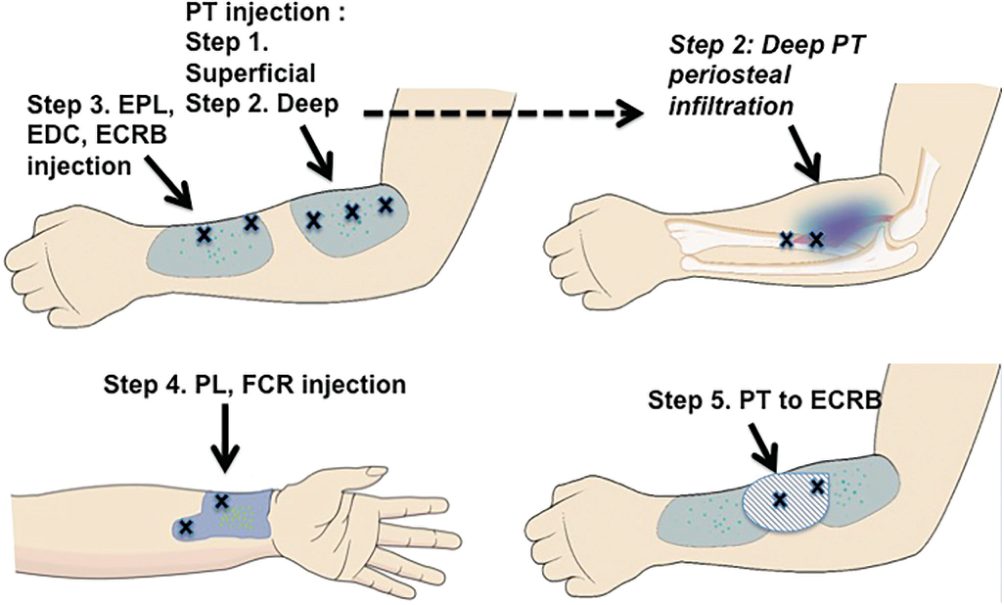
The guidelines' two lists
The 2023 office guidelines draw the line at the permanent implant: an operation that leaves one behind belongs under full sterility in an accredited operating room; most of the rest can be done in the office under field sterility (Schank 2023, table 4). Their lists, condensed:
| Appropriate for office WALANT | Consider main operating room sterility |
|---|---|
| Excision of benign or malignant skin lesions confined to skin and subcutaneous tissue; skin grafts and local flaps | Permanent internal fixation of fractures; elective joint implant surgery; bone graft and fusion surgery |
| Trigger and tendon release; tenolysis; primary Dupuytren's fasciectomy | Carpectomy; complex revision of a nerve decompression; nerve transfers |
| Basic hand and forearm trauma care, including nerve, ligament and tendon repairs; open contaminated hand fracture care; hand fracture management by K-wire | Complex deep forearm surgery, such as multiple forearm tendon transfers; complex compartment syndrome release; the mangled hand |
| Primary peripheral nerve decompressions | Severe infection |
| Simple wrist tendon transfers, such as extensor indicis proprius to extensor pollicis longus | Deeply invading malignancy; lymph node basins and sentinel node biopsy |
| Simple hand infections such as a felon; early flexor synovitis or fight-bite drainage when the cellulitis is very limited | Most congenital differences in children, other than a type 1 accessory digit |
| Mucous cyst and ganglion excision; finger amputation; simple accessory digit | Recurrent complex Dupuytren's surgery, such as dermofasciectomy |
Setting up
The itemized build from the SurgiColl case study: an office surgery suite in a standard procedure room for $9,614.57, excluding the X-ray unit. Ten steps.
Any exam room can become a procedure room. You need a comfortable place for the patient to sit or lie, a stable surface to operate on, a stand or table for the instruments, good light, and a rolling stool. Like furnishing a house, there is a wide range of taste and budget. What follows is what Heritage bought, with the prices paid. The full paper, with every line item, is open access: Clarkson and Ilyas 2026.
The room
- Patient position. A treatment table or chair that is easy to mount and dismount. Motorized is nice; static is adequate ($300 to $1,000 new). Heritage uses an electric exam chair ($2,393).
- Surgical surface. A mobile hand table that rolls in and rolls away ($100 to $2,000 new), or the cost-effective alternative: a mobile adjustable-height standing desk. Heritage uses two, at $107 each.
- Instrument table. A mobile stainless-steel back table ($150), or a fixed counter in reach.
- Light. A headlamp ($10 to $100), free-standing procedure lights on wheels ($1,000 to $5,000), or ceiling lights. Heritage runs on loupes with a headlight ($800).
- Stools. A rolling stool for the surgeon and assistant ($50 to $150; Heritage paid $85).
- What the guidelines list. A basic procedure room needs access to sterile instruments and a gurney with an arm table or a reclining procedure chair, an operating light or headlight, a mini C-arm if you will manage fractures, and a virtual reality headset for the patient who wants one (Schank 2023, table 6).
- What you do not need. Operating-room ventilation: a clinic procedure room with six air changes an hour had the same flexor-tendon infection rate as the operating room with 25 (Tessier 2025). Gowns or caps: the 437-case Wilde series ran without ventilation, gowns or caps and had no deep infection; the Swedish consulting-room series operated in ordinary clothes and a plastic apron (Hedspång 2026). Space: a Veterans Affairs minor procedure room of 231 square feet did the work of a 524 square-foot operating room (Look 2020). Monitoring: the 1,011-case office series used none (McKnight 2022); the 1,771-case surgery-center series used one nurse (Schindelar 2022).
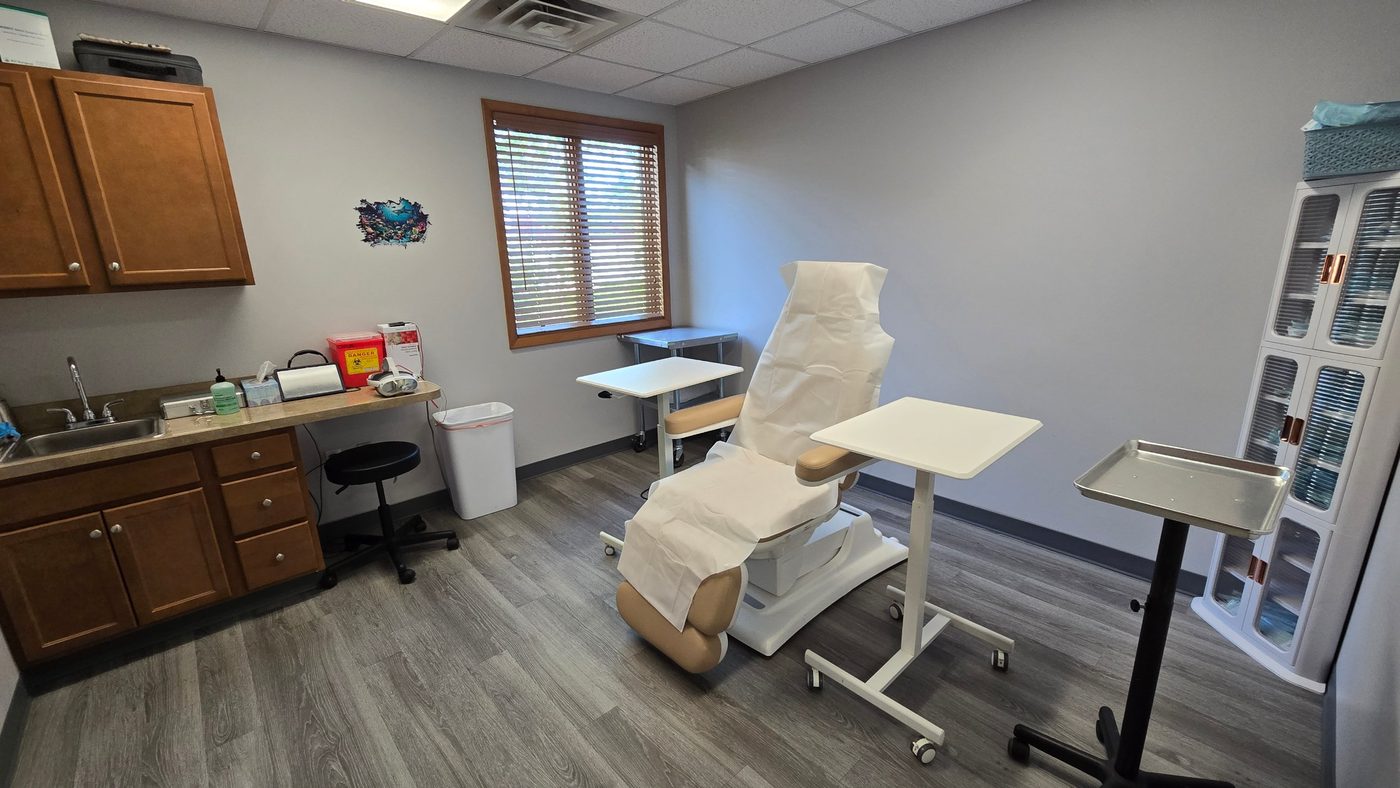
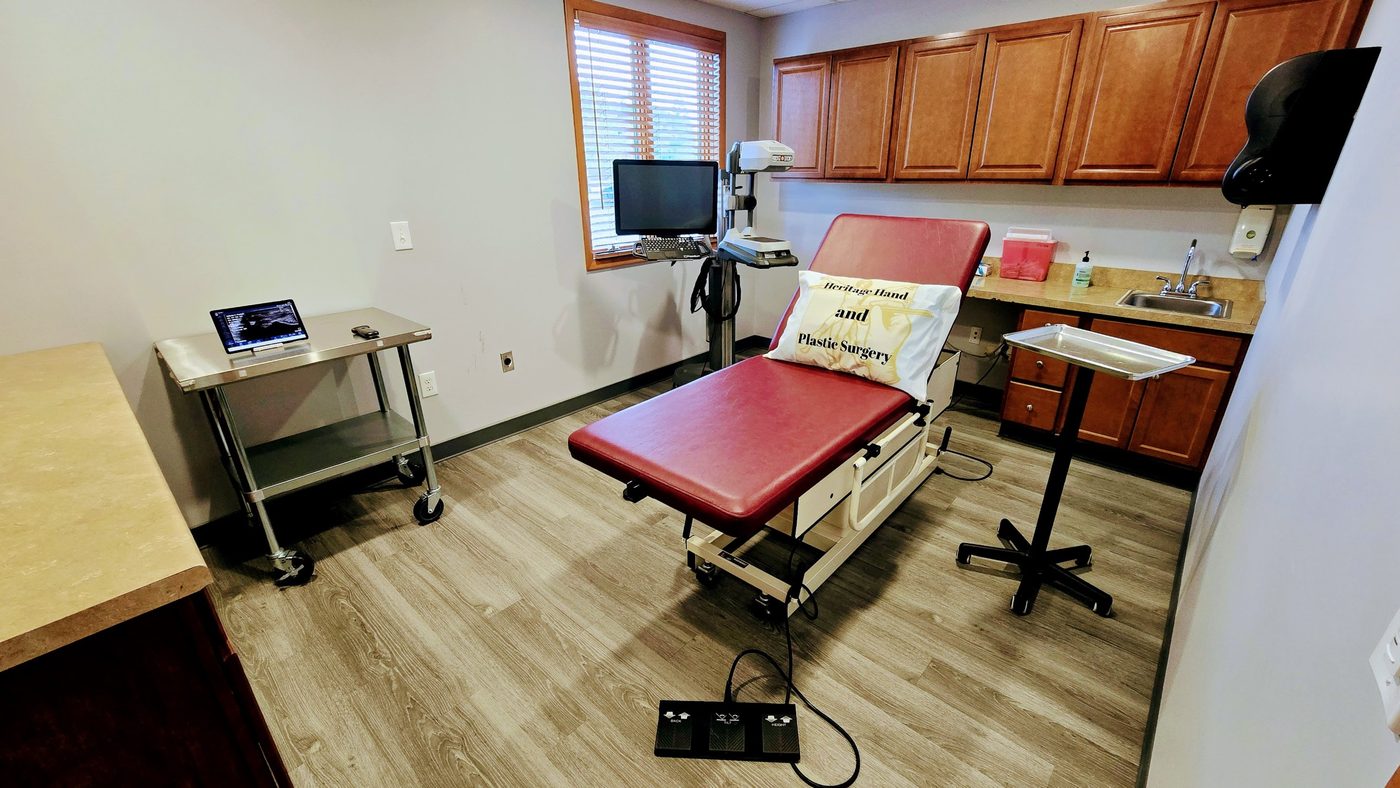
Other practices' rooms, from the published series:
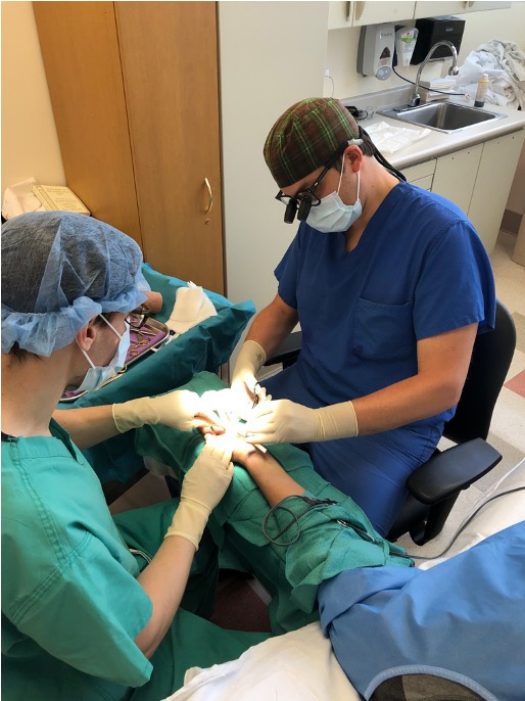
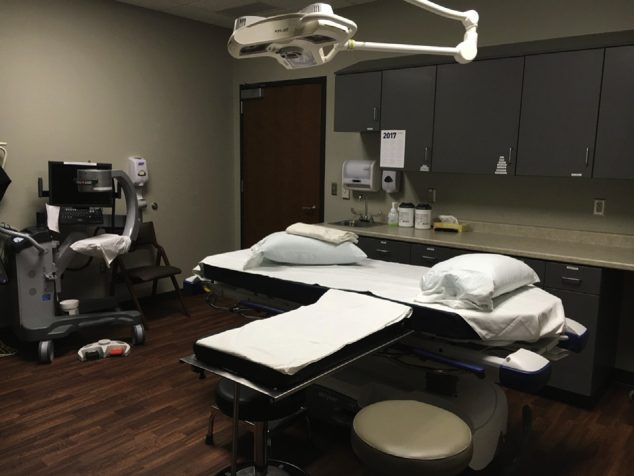
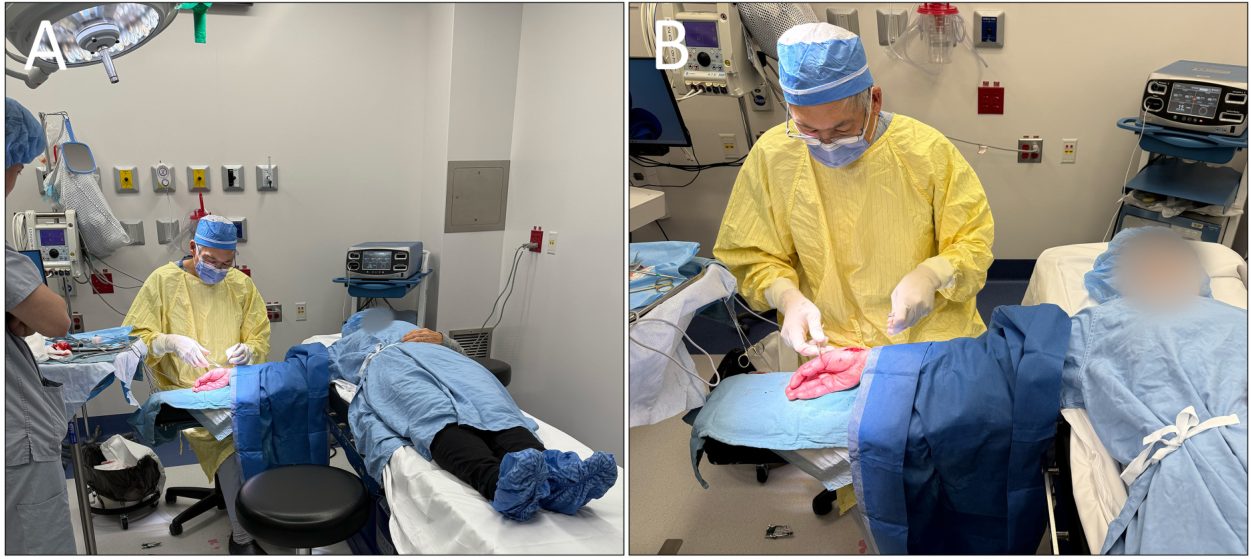
Instruments
The minimum set for office hand surgery: scalpel handle, Adson toothed forceps, Senn-Miller retractors, iris scissors, Stevens tenotomy scissors, bandage scissors, mosquito hemostat, needle driver, Freer elevator, a stainless cup and two towel clamps. Wrap each set in a sterile towel for the autoclave rather than buying trays. Buy as many identical sets as your list and your processing time need; Heritage runs ten.
| Instrument | Unit | Ten sets |
|---|---|---|
| Adson tissue forceps, 1×2 teeth, 4.75 in | $10.99 | $109.90 |
| Iris scissors, 4.5 in, curved | $5.00 | $49.99 |
| Mayo-Hegar needle holder, 5 in | $9.99 | $99.90 |
| Stevens tenotomy scissors, 4.5 in, curved | $9.99 | $99.90 |
| Bandage scissors, 5.5 in | $5.83 | $58.33 |
| Scalpel handle #3 | $4.50 | $44.99 |
| Mosquito hemostat, 5 in | $1.50 | $14.99 |
| Senn-Miller retractors | $8.50 | $84.95 |
| Freer elevators | $9.45 | $94.53 |
| Towel clamps, 3.5 in (two per set) | $3.24 | $64.82 |
| Stainless steel cups, 6 oz | $1.91 | $19.07 |
| Ten complete sets | $741.37 |
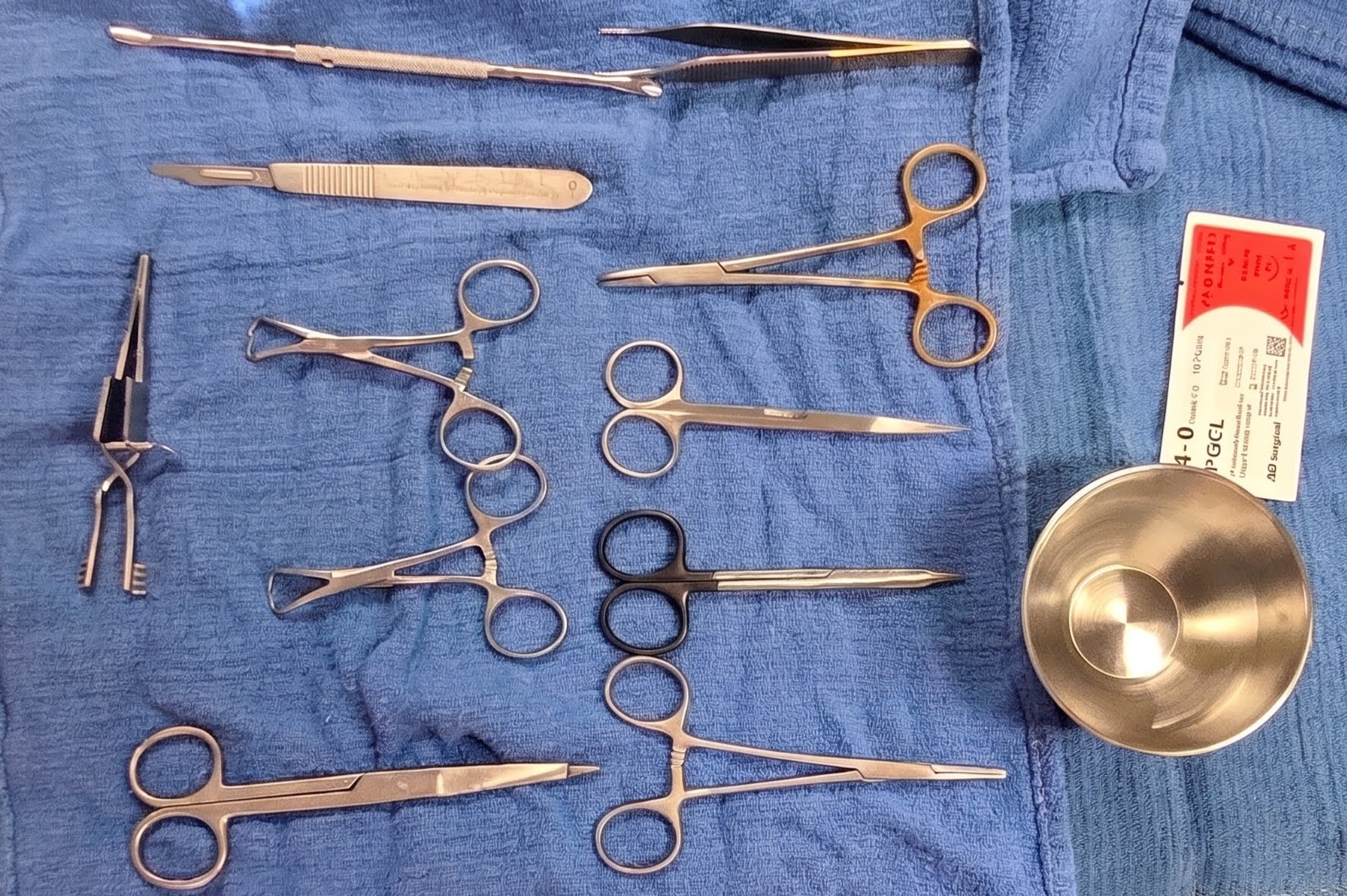
The guidelines' basic tray is the same list from the other direction: four sterile towels and two Allis forceps to hold them, a Senn retractor, toothed Adson forceps, iris and Mayo scissors, a #15 knife handle, one hemostat, a needle driver and a small sterile cup, with skin hooks, Weitlaner and Heiss retractors, tenotomy scissors, rongeurs, a finger tourniquet, a Freer elevator, a K-wire driver and wires, and a range of sutures wrapped separately (Schank 2023, table 6).
A reserve of individually packed specialty instruments (skin hooks, Weitlaner and Heiss retractors, bone rongeur, K-wire cutter and remover, reduction forceps, Weingart pliers) added $429.19. Most of this was sourced from Pakistani manufacturers through online bulk vendors. A basket of 86 instruments that cost $680.58 that way lists at $7,919.14 from United States distributors, 11.6 times more. A basic set costs $50 to $100 sourced overseas and $500 to $1,500 bought new domestically.
Capital equipment
| Item | Cost |
|---|---|
| Midmark M11 cassette autoclave | $4,060.00 |
| Electric exam chair (operating table) | $2,393.00 |
| Surgical hand drill | $539.07 |
| Surgical loupes with headlight | $800.00 |
| Furniture and ancillaries Two standing desks as hand tables, 40 cotton sterile towel drapes, back table, stool, pillows, office camera | $651.94 |
| Core instrument sets (above) | $741.37 |
| Specialty and reserve instruments | $429.19 |
| Total setup | $9,614.57 |
Excluded: the fluoroscope, the single largest and most variable cost. New units run $10,000 to $50,000 (tabletop mini C-arm, small C-arm, large C-arm, or a built radiology suite); the used and aftermarket market is large and Heritage bought second-hand. Also excluded: electrosurgical cautery ($1,000 to $5,000 new, rarely needed), dedicated procedure lights, and the recurring supplies: sutures, local anesthetic, splinting, sterilization consumables and personal protective equipment.
A steam autoclave costs $1,500 to $5,000 new depending on size. Buy for the volume of instruments you will process, not the volume of cases.
Instrument processing
Sterilization is the biggest ongoing burden of an office practice, because it is the work a hospital's central supply department does for you. The office is not certified; what it needs is a written workflow that prevents contamination and cross-infection, followed every time. Heritage runs its autoclave on a counter with clean working space beside a sink. The staff list:
- Wipe and rinse, then enzymatic soak for 12 minutes.
- Scrub with soft nylon brushes to remove bioburden. Rinse.
- Air-dry on a clean towel.
- Package: a set wrapped in sterilization wrap or a towel, or single instruments in pouches, sealed with indicator tape.
- Autoclave on the pre-set instrument cycle, with a dated indicator strip in the pack.
- Store dry. Packs are held sterile for six months.
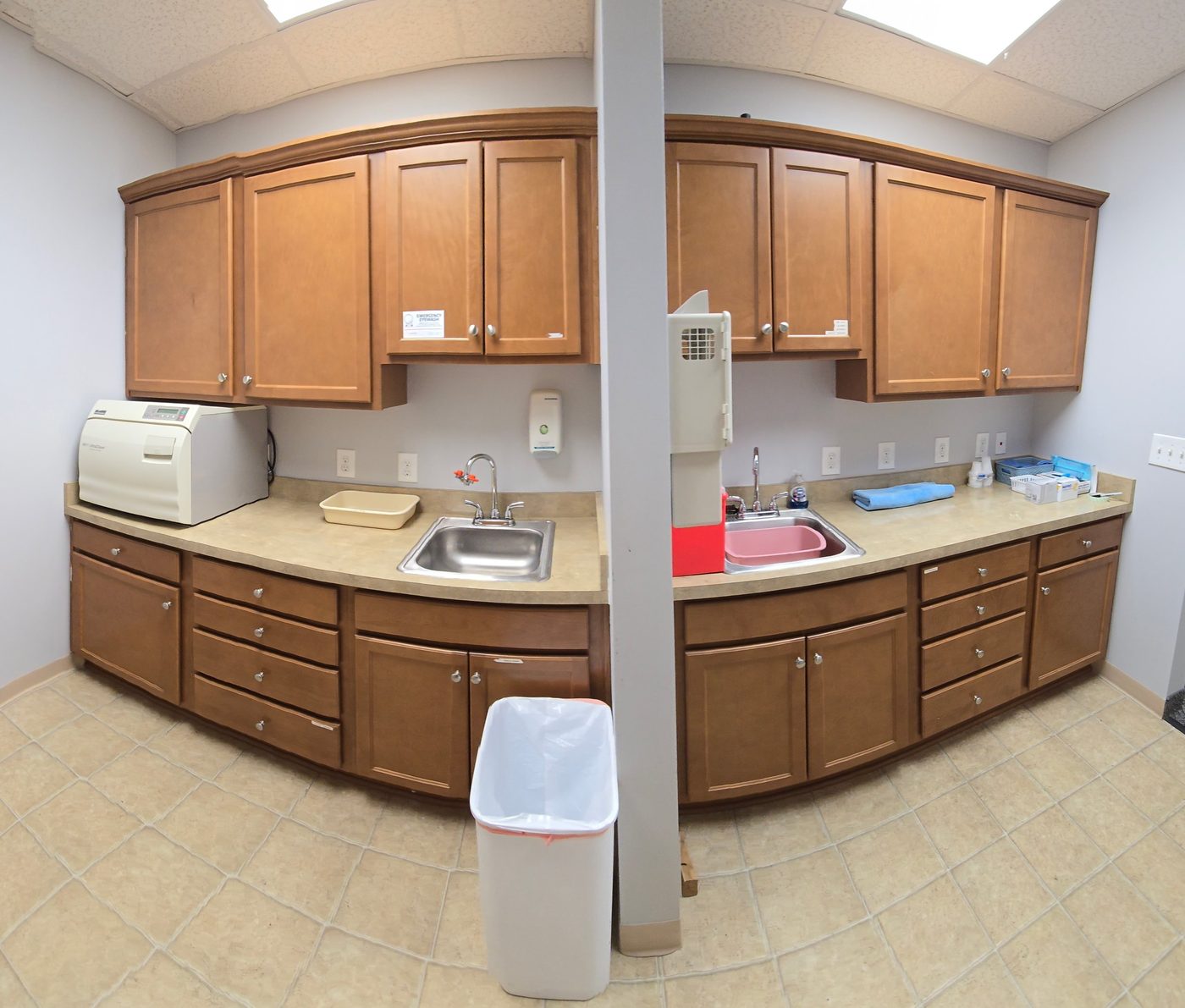
Brief the team on the Centers for Disease Control and Prevention (CDC) sterilization guidelines, use indicators routinely, and have the autoclave serviced on schedule. State rules on clean and dirty space vary; check your own state's requirements beyond the CDC's recommendations.
For the office manager: the routine, in order
This is the order every instrument set follows, from the chair to the shelf. Where the maker of your cleaner, sterilizer or packaging gives more specific instructions, follow those. The steps below are drawn from the Philadelphia Department of Public Health's office reprocessing procedure (2019), the AORN decontamination guidance (2014) and the ambulatory sterilization references (Patrick 2011; 3M webinar 2024, which cites the AAMI standard ST79).
- At the chair. Rinse off blood and debris as soon as the case ends. If the set has to wait, keep it moist, covered, with a damp towel or enzymatic spray. Never leave soiled instruments overnight.
- Carry it in a container marked "clean transport only" once it is rinsed. Keep it separate from anything already clean.
- Pre-soak in enzymatic detergent for the time the detergent maker gives. Change the water often; it can look soiled after a single set.
- Scrub under water with a disposable brush until all debris is gone. Open hinged instruments. Flush any lumened instrument with a syringe and bottle brush. Discard brushes daily or when heavily soiled.
- Rinse, preferably with distilled or deionised water so that no mineral residue is left, then dry with a clean, lint-free cloth.
- Inspect every instrument under good light. Set aside anything damaged or still dirty. Send dirty instruments back to the cleaning step.
- Package: a pouch of the right size with no holes or tears; hinged instruments open; tip protectors on sharp items; never overpack; a chemical indicator inside every pouch; seal with no creases or gaps; label with the date and the sterilizer used.
- Sterilize on the cycle your sterilizer maker gives for wrapped instruments. Load so that steam can reach every pack, and leave space between packs. Do not sterilize unwrapped instruments in unsterile containers.
- Check the indicators for the correct colour change before anything goes to storage.
- Store dry, in a closed area, away from anything that can crush, bend or puncture the pack. Do not open a pack until it is needed. A pack that is torn, damp or already opened is reprocessed.
Trays, wraps and towels
The sources I found describe peel pouches and rigid containers. Neither of them gives a method for towel-wrapped sets. Use the packaging your sterilizer maker validates. A sterile towel is not a sterilization wrap unless the sterilizer maker says it is, so confirm this with the maker before you wrap any set in towels. The trays-or-wraps choice is a cost and workflow decision, not a safety one, provided the packaging is validated for your machine. I did not find an office-specific reference for towel wrapping, and that gap should be closed with the maker and the AAMI standard before the practice relies on it.
Testing and records
- Daily: if your sterilizer uses a dynamic air-removal cycle, run a Bowie-Dick test before the first load (3M webinar 2024).
- Every pack: a chemical indicator inside, and an external one on the outside (3M webinar 2024).
- Weekly at least: a biological (spore) indicator. Many practices run it daily. Send it for processing promptly and keep the result (Philadelphia 2019); Patrick 2011.
- Every load: a log with the date, start and end times, cycle, temperature, pressure, indicator results and the operator's initials (Philadelphia 2019).
- If a biological indicator fails: find the cause, recall every load back to the last passing indicator and reprocess it, and do not use the sterilizer until the fault is fixed and several test loads pass (Patrick 2011); (3M webinar 2024).
The instruments we use
A starting list from our own sets. Each practice changes it:
- Scalpel handle, with blades
- Adson toothed forceps; iris scissors; Stevens tenotomy scissors; bandage scissors
- Senn-Miller retractors
- Mosquito hemostat; needle driver; Freer elevator
- A stainless cup and two towel clamps
Medications and disposables
- One percent lidocaine with 1:100,000 or 1:200,000 epinephrine, stocked to the list: 3 to 50 mL a case.
- 8.4% sodium bicarbonate, 1 mL per 10 mL of local.
- Phentolamine, smelling salts; an oral cephalosporin if you prefer prophylaxis.
- Per case: a #15 blade, 10 mL syringes, 25- and 27-gauge needles (a 30-gauge for the first poke), sutures and dressings to suit the list.
- Keep enough stock to cover reorder time, and weigh bulk pricing against storage.
Staff and running costs
Heritage runs on three and a half staff for a surgeon who is also seeing clinic, imaging and injecting. The running cost of $25,126 a month covered rent on half a building, those staff, supplies, insurance and the imaging room. Price your own room against the hours you will be in it: at Heritage every hour the surgeon is in the office costs $322. Cash covered costs in month four on the surgeon's own volume, with one contracted day a week elsewhere carrying the first months.
The guidelines' clinic, in one line: one procedure room, one small instrument-cleaning room with an autoclave, two injection rooms, one surgeon, one medical assistant who rooms and circulates, and, optionally, a midlevel provider or qualified resident who gives the blocks and closes (Schank 2023, table 7). The two injection rooms are what keep the surgeon one or two patients ahead all afternoon.
The procedure room itself needs one other person. Lalonde's unit runs three carpal tunnel releases an hour on one surgeon, one nurse and one receptionist (Degreef 2024); in the time-driven costing study the procedure room used 43 percent fewer staff than the operating room for the same case (Serhan 2026); the Association of periOperative Registered Nurses' 2020 guidance permits a single registered nurse for local-anesthetic procedures (Koehler 2026). Nobody in the room is there for the anesthetic.
Who to book
- Book freely: the elderly (walk-in, walk-out carpal tunnel release in patients over 80 scored 5.9 out of 6 for satisfaction; Lech 2021); patients with psychiatric diagnoses (same procedural pain, 95% would repeat; Ford 2024); anticoagulated patients (never stopped in the 616-case Spanish office series, no bleeding; Far-Riera 2022). Comorbidity was not an exclusion in the Veterans Affairs procedure rooms (Look 2020).
- Book with care: smokers and patients with autoimmune disease, who did worse in the office than in the operating room in the one series that looked (Carter 2026); anyone whose operation will run past ninety minutes, where the top-ups and tourniquet rescues cluster (Takagi 2022); the very anxious patient who cannot keep still, who is the usual conversion.
- Keep in the hospital: implants of any size (no office series places them; Oakes 2022 advises operating-room sterility), revascularization, and anything over about two hours.
- Avoid epinephrine: coronary artery disease that is not controlled, with breakthrough angina. This site's author has induced angina with it, infiltrating 1% lidocaine with 1:200,000 epinephrine at 7 mg/kg beneath a calciphylaxis eschar on a medial thigh. Personal communication, Clarkson 2026.
- Vascular disease, Raynaud's, Buerger's, scleroderma: the epinephrine series mostly excluded them, so the safety data are thin. The few published ischemias mostly had a risk factor or a large volume behind them; one had neither (Frey 2025). Use judgment and keep the phentolamine close.
Billing and site of care
- Bill the procedure code from your office at the non-facility rate, as you already bill an injection. There is no facility claim, because there is no facility.
- Verify site of care from the billing system, not from memory, so you can show your own numbers in a year.
- Publish one whole price for the patient who opts out of their plan and pays in full, and record their request to restrict disclosure to the plan.
- Offer the main operating room to everyone, at no extra charge from you, and mean it.
- If you are considering a fee for the setting itself, read the caution on the economics page and take your own legal advice before you charge one.
The patient experience
The office is the one setting where the surgeon controls the whole experience. Hospitality has used environmental cues for a century; an office suite can do the same. Dr Jean Paul Brutus in Montreal added music and a light show during surgery. Heritage furnished the waiting room with surgical antiques and a family history in surgery spanning 150 years, and puts a virtual reality headset on the patient in the chair. Patients notice, and they tell people.
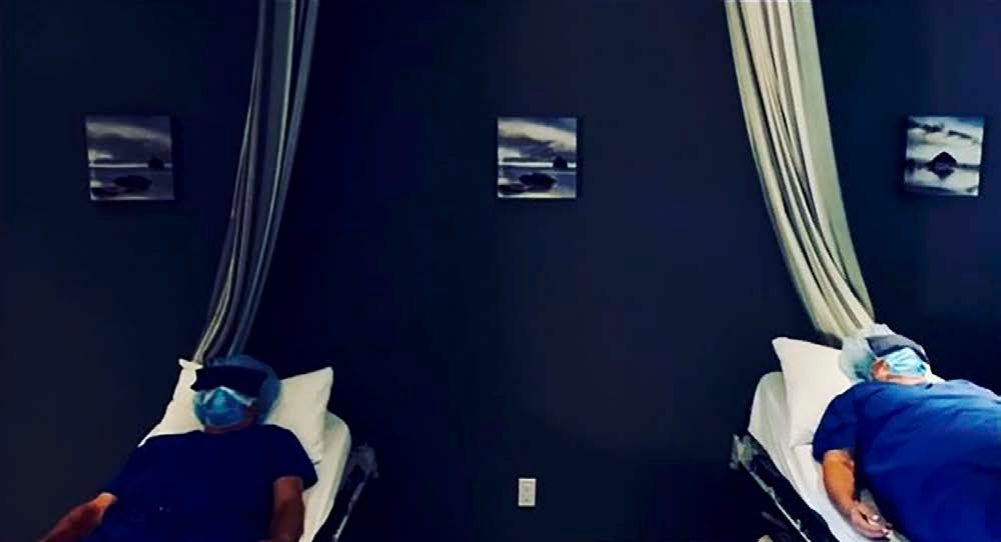
State rules
Office-based surgery regulation is set state by state. Most state accreditation and registration schemes are triggered by sedation or general anesthesia and leave procedures under local anesthesia alone (California's Health and Safety Code section 1248, for one, exempts local anesthesia), but the detail differs, and some states regulate by procedure or by facility. Read your own state medical board's rules on office-based surgery before you open, and keep a written copy of what applies to you.
The literature
What 270 open-access papers on WALANT say, read in full in November 2026, and where they are thin.
The field is young and it is accelerating. PubMed holds 388 free-to-read papers with WALANT or wide-awake hand surgery in the title or abstract. One was published in 2011. Seventy were published in 2025. The 270 of them whose licence allows the full text to be read in bulk were read, every page, for this site; the other 118 are free to read one at a time at the publisher. What follows is what they say, by theme, and then what they do not yet say.
Open-access WALANT papers on PubMed by year (2026 is to early November)
| 2011 | 1 | 2017 | 10 | 2022 | 63 |
| 2012 | 2 | 2018 | 7 | 2023 | 47 |
| 2013 | 1 | 2019 | 19 | 2024 | 60 |
| 2015 | 4 | 2020 | 21 | 2025 | 70 |
| 2016 | 4 | 2021 | 42 | 2026 | 37 |
How the evidence is built
Of the 388: fourteen randomized trials, four meta-analyses, ten systematic reviews, forty narrative reviews, forty-six case reports, and the rest cohorts and case series. The randomized base is small. The eleven trials pooled in 2025 hold 794 patients between them, follow them for weeks rather than years, and compare the anesthetic, not the building. No trial has ever compared field sterility with operating-room sterility; the equivalence rests on the large cohorts, the national claims, and the Veterans Affairs series that ran both rooms side by side. The claims studies, which supply the biggest numbers, cannot tell whether a case was WALANT at all, only where it was done. The largest office carpal tunnel series are industry registries for an ultrasound-guided device. The narrative reviews re-quote the same fifteen primary studies, and not always accurately, which is why every figure on this site is taken from the primary paper. Four papers print one number in the abstract and a different one in the results; the results are used. One paper that would otherwise be cited, a 2020 randomized trial of distal radius plating, has been retracted and is not.
Two more habits of this literature. Half the technique papers do not say whether they buffered the local, and most do not say whether they gave antibiotics. And the office is rare in it: of the 270 papers read, only about twenty-five report a true office, consulting-room or minor-procedure-room series. Those twenty-five carry the weight of this site.
What the papers say, by theme
37 papers
The technique is settled: 1% lidocaine with 1:100,000 epinephrine, buffered ten to one, 27- to 30-gauge needles, 7 mg/kg, 25 to 30 minutes. The reviews agree that cost is set by the building and that no review has found a higher infection rate with field sterility in any setting. Only five of the 37 pool anything. The orthopaedic guideline of 2024 endorses local anesthesia alone on high-quality evidence and the office on limited evidence.
Read first: Degreef and Lalonde 2024; Lawand 2024; Chou 2026.
18 papers
The office matched or beat the operating room in every comparison: 37,602 trigger releases, 2,182 patients at one practice, 538 in one surgeon's transition, 174 flexor tendon repairs. 1,771 awake cases ran on one nurse with nothing aborted. Epinephrine's effects are counted and minor: 2.2 percent a brief rush, 1.8 percent a faint, a fingertip briefly pale. At the full dose, serum lidocaine stays under the toxic threshold. No series reports a lost finger; the three case reports that did had no phentolamine.
Read first: Kazmers 2021; Carter 2026; Greene 2021.
23 papers
The same operation costs 6.3 times more in the operating room than in the procedure room; staff cost per case is a quarter; the payer pays 30 to 48 percent less; waste falls by three-quarters and carbon by four-fifths. The surgeon's fee moves a few tens of dollars either way. The honest counterweights: German day-case tariffs pay 19 to 33 percent less without an anesthetic, and a group that shares a facility fee has a reason to prefer the building that charges one.
Read first: Kazmers 2018; Serhan 2026; Lalchandani 2019.
48 papers
Buffering cuts injection pain from 5.8 to 2.2 out of 10 and is associated with fewer complications; the 10:1 mix reaches pH 7.3 and keeps two weeks. Bupivacaine adds twelve hours of numbness and little else. The one open question is the wait: the papers range from five to sixty minutes, the mode is 25 to 30, and the series that cut it short paid in tourniquets. Replacing the epinephrine with tranexamic acid only lengthened the operation (Kamimura 2026).
Read first: AlShammari 2025; Kang 2019; Saleh 2021.
22 papers
Between 87 and 100 percent of patients would choose it again, in every country asked. Pain during the operation is near zero; the injection and the anticipation are the real discomforts, and headphones halve the second. Patients go home on acetaminophen. Against the surgery center, the office wins on days off work, not on satisfaction, which is 9.7 out of 10 in both. A block done by an anesthesiologist can score higher than a WALANT done in a hurry.
Read first: Govender 2025; Townsend 2021; Sraj 2019.
15 papers
Two percent of wide-awake carpal tunnel releases in the United States are done in an office. Surveyed surgeons name the tourniquet habit, institutional anesthesia rules, billing codes, anesthetist remuneration and room space as the reasons, and epinephrine almost never. Residents rate the educational value of awake surgery no higher than the operating room's. The office series that exist (a standard exam room, Swedish consulting rooms, a Calgary minor suite, a Spanish district hospital) report no deep infections.
Read first: Grandizio 2020; Kammien 2026; Milhoan 2024.
69 papers
Everything from a trigger finger to a shoulder disarticulation has been done awake. Office numbers exist for the common releases, mass excisions and hand fracture fixation; hospital numbers for distal radius and forearm plating, basal joint arthroplasty, tendon reconstruction and nerve transfers. Conversions cluster where the surgery is long, deep or proximal: 17.5 percent for ulnar nerve transposition, one in sixteen for basal joint arthroplasty, top-ups past ninety minutes.
Read first: Far-Riera 2022; Hunziker 2025; Tu 2022.
38 papers
One epinephrine ischemia in the whole set, four hours after discharge, reversed. No infection, no systemic toxicity, no cardiac event, including in patients on three antithrombotics, in uncontrolled atrial fibrillation and with complete heart block. Three Calgary reports spell out an office field-sterility setup for scaphoid screws and proximal row carpectomy: chlorhexidine, two towels, one drape, scrubs and sterile gloves, no fasting, no anesthetist.
Read first: Frey 2025; Ponich 2024.
Where the evidence is thin
- No office series places an implant. The fracture fixation data are from outpatient theatres and minor procedure rooms, not exam rooms.
- The office rheumatoid and tendon-transfer entries rest on one practice's experience, reported here as a personal communication, not yet on a published series.
- Flexor tendon repair in a procedure room rests on one series of 93. Distal radius plating is not yet a procedure-room operation, by its own reviewers' account.
- Patients with vascular disease, Raynaud's or scleroderma were excluded from nearly every epinephrine study. The reassurance does not extend to them.
- The wait before incision has never been settled by a trial of adequate size.
- Nobody has shown the office makes the operation itself any better. The outcome data say the same; the preference data say most patients, not all: in a bilateral trial where each patient had one side each way, 59 percent preferred local only and 34 percent preferred sedation (as reported by Stocker-Downing 2025).
- The office infection rate depends on the definition more than on the room, and most series do not say which they used.
- Superficial infection runs higher after double trigger releases (7.3 percent in the largest office series), and complications were commoner in smokers operated on in the office than in the operating room (Carter 2026). Nobody has yet studied why.
References
Every figure on this page traces to one of these. Journal citations checked against PubMed, November 2026.
In November 2026 this site was checked against every open-access paper on WALANT in PubMed Central, 270 papers read in full, and revised where they added to it or disagreed with it. The ones it draws on are below. One paper that would otherwise have been cited, a 2020 distal radius trial, has been retracted and is not. Where a paper's abstract and results disagree, the results are used.
The setup paper
- Clarkson JHW, Ilyas AM. How to set up an office-based surgical suite: a case study guide. SurgiColl. 2026;4(3). Open access. doi:10.58616/001c.166229
- Ilyas AM, Clarkson JHW. Wide awake surgery: a review of cost savings potential. SurgiColl. 2024;2(4). doi:10.58616/001c.125563
- Schank KJ, Engwall AJ, Kuhns BW, Oakes TC, Bray SM, Clarkson JHW. Guidelines for wide-awake local anesthesia surgery with no tourniquet in the office setting using field preparation sterility. Plast Reconstr Surg. 2023;151(2):267e–273e. doi:10.1097/PRS.0000000000009850
- Clarkson JHW, Park SK. Wide-awake local anesthesia with no tourniquet (WALANT) for the injured hand. In: Couceiro J, Sanchez-Crespo RM, Yuan Tien H, eds. The Handbook of Hand Emergencies. 2nd ed. Newcastle upon Tyne: Cambridge Scholars Publishing. Chapter 25. First edition: Clarkson J, Manon-Manto Y, 2020.
- Clarkson P, Deuchard DC. Treatment of open digital injuries and the training of dressers in tissue craft. Proc R Soc Med. 1950;43(12):1063–1065. Free full text in PubMed Central. doi:10.1177/003591575004301221
Practice data
- Heritage Hand and Plastic Surgery operating data, April 2025 to June 2026, presented by James Clarkson, "Starting a new office-based WALANT practice", American Society for Surgery of the Hand Annual Meeting, Boston, September 2026.
- Clarkson JHW. Personal communication, November 2026. Office WALANT soft-tissue rheumatoid surgery and extensor tendon transfers (extensor hood centralization, extensor tendon transfers, wrist synovectomy with retinacular transposition) at Heritage Hand and Plastic Surgery, East Lansing, Michigan, and previously at Michigan State University.
- Clarkson JHW. Personal communication, November 2026. Angina induced during infiltration of 1% lidocaine with 1:200,000 epinephrine at 7 mg/kg beneath a calciphylaxis eschar of the medial thigh, in a patient with uncontrolled coronary artery disease. Heritage Hand and Plastic Surgery, East Lansing, Michigan.
Economics
- Starr BW, Davenport RO, Granzow D, Johnson SP, Lien JR. Optimizing the use of operating rooms by transitioning common hand surgeries into the office setting. J Hand Surg Am. 2023;48(3):217–225. doi:10.1016/j.jhsa.2022.11.010
- Chatterjee A, McCarthy JE, Montagne SA, Leong K, Kerrigan CL. A cost, profit, and efficiency analysis of performing carpal tunnel surgery in the operating room versus the clinic setting in the United States. Ann Plast Surg. 2011;66(3):245–248. doi:10.1097/SAP.0b013e3181db7784
- Rhee PC, Fischer MM, Rhee LS, McMillan H, Johnson AE. Cost savings and patient experiences of a clinic-based, wide-awake hand surgery program at a military medical center: a critical analysis of the first 100 procedures. J Hand Surg Am. 2017;42(3):e139–e147. doi:10.1016/j.jhsa.2016.11.019
- Halvorson AJ, Sechriest VF, Gravely A, DeVries AS. Risk of surgical site infection after carpal tunnel release performed in an operating room versus a clinic-based procedure room within a Veterans Affairs medical center. Am J Infect Control. 2020;48(2):173–177. doi:10.1016/j.ajic.2019.08.004
- Kazmers NH, Presson AP, Xu Y, Howenstein A, Tyser AR. Cost implications of varying the surgical technique, surgical setting, and anesthesia type for carpal tunnel release surgery. J Hand Surg Am. 2018;43(11):971–977.e1. doi:10.1016/j.jhsa.2018.03.051
- White M, Parikh HR, Wise KL, Vang S, Ward CM, Cunningham BP. Cost savings of carpal tunnel release performed in-clinic compared to an ambulatory surgery center: time-driven activity-based costing. Hand (N Y). 2019;16(6):746–752. doi:10.1177/1558944719890040
- Hurley LJ, Hardie KA, Van Demark RE. A cost analysis of carpal tunnel procedures performed in an office procedure room versus a hospital operating room in a rural midwest health system. Plast Surg (Oakv). 2026; published online March 21. doi:10.1177/22925503261429901
- Billig JI, Nasser JS, Chen JS, et al. Comparison of safety and insurance payments for minor hand procedures across operative settings. JAMA Netw Open. 2020;3(10):e2015951. doi:10.1001/jamanetworkopen.2020.15951
- Carr LW, et al. Direct cost comparison of open carpal tunnel release in different venues. Hand (N Y). 2019;14(4):462–465. doi:10.1177/1558944718755476
- Serhan KA, et al. A Time-Driven Activity-Based Costing Analysis of Minor Hand Procedure Room Utilization at a Single Military Institution. J Hand Surg Glob Online. 2026;8(3):101005. doi:10.1016/j.jhsg.2026.101005
- Maliha SG, et al. A Cost and Efficiency Analysis of the WALANT Technique for the Management of Trigger Finger in a Procedure Room of a Major City Hospital. Plast Reconstr Surg Glob Open. 2019;7(11):e2509. doi:10.1097/GOX.0000000000002509
- Lalchandani GR, et al. Wide-Awake Local Anesthesia for Minor Hand Surgery Associated With Lower Opioid Prescriptions, Morbidity, and Costs: A Nationwide Database Study. J Hand Surg Glob Online. 2019;2(1):7–12. doi:10.1016/j.jhsg.2019.09.011
- Far-Riera AM, et al. Impact of WALANT Hand Surgery in a Secondary Care Hospital in Spain. Benefits to the Patient and the Health System. J Hand Surg Glob Online. 2022;5(1):73–79. doi:10.1016/j.jhsg.2022.10.003
- Hedspång M, et al. Patient experience after shared medical appointments and in-office WALANT carpal tunnel release: a prospective evaluation of satisfaction, cost and waste reduction. JPRAS Open. 2026;52:206–212. doi:10.1016/j.jpra.2026.08.017
- Levit T, et al. Trigger Finger Release Using Wide-Awake Local Anesthesia No Tourniquet Versus Local Anesthesia With a Tourniquet: A Systematic Review and Meta-analysis. Hand (N Y). 2024;20(4):533–541. doi:10.1177/15589447231222517
- Koehler SM, et al. What's New in Wide-Awake Local Anesthesia No Tourniquet (WALANT) Hand Surgery?. J Hand Surg Glob Online. 2026;8(4):101033. doi:10.1016/j.jhsg.2026.101033
- Shulkin A, et al. Reducing the Carbon Footprint of Hand Surgery: An Environmental Analysis of the Wide Awake Local Anesthesia No Tourniquet Approach for Pediatric Trigger Thumb Release. J Hand Surg Glob Online. 2026;8(6):101037. doi:10.1016/j.jhsg.2026.101037
- Knopp BW, et al. Patient Experiences With Hand Surgery in the Office Versus Ambulatory Surgery Center. Cureus. 2023;15(8):e43763. doi:10.7759/cureus.43763
- Ponich BJ, et al. WALANT Technique Scaphoid Fracture and Wrist Surgery With Field Sterility. Plast Reconstr Surg Glob Open. 2025;13(3):e6576. doi:10.1097/GOX.0000000000006576
- Degreef I, Lalonde DH. WALANT surgery of the hand: state of the art. EFORT Open Rev. 2024;9(5):349–356. doi:10.1530/EOR-24-0033
- Trautz B, et al. Economic benefits of WALANT anaesthesia in metacarpal and phalangeal fracture surgery. J Hand Surg Eur Vol. 2026;51(5):617–622. doi:10.1177/17531934251409627
- Yen CY, Ma CH, Wu CH, Yang SC, Jou IM, Tu YK. A cost and efficacy analysis of performing arthroscopic excision of wrist ganglions under wide-awake anaesthesia versus general anaesthesia. BMC Musculoskelet Disord. 2020;21(1):459. doi:10.1186/s12891-020-03482-0
- Santos Lopes C, Lalonde DH, Ribak S, Almeida A, Ferreira D, Marques-Gomes J. WALANT versus sedation for hand trauma: a comparative cost analysis in a Portuguese public hospital. Plast Reconstr Surg Glob Open. 2026;14(9):e8124. doi:10.1097/GOX.0000000000008124
Rooms and trays
- Segal KR, Debasitis A, Koehler SM. Optimization of carpal tunnel syndrome using WALANT method. J Clin Med. 2022;11(13):3854. doi:10.3390/jcm11133854
- Platt A, Graff MF, Ponich B, Knox A. WALANT thumb CMC joint denervation under field sterility: a case report and description of technique. Plast Surg (Oakv). 2026; published online April 9. doi:10.1177/22925503261436369
Uptake, reimbursement and staffing
- Kammien AJ, Kim S, Mookerjee VG, et al. Wide-awake carpal tunnel release in the United States: trends in volume and reimbursement by operative setting. Plast Reconstr Surg. 2024;154(1):143–149. doi:10.1097/PRS.0000000000010961
- Kammien AJ, Salib A, Prsic A, Grauer JN, Colen DL. Current trends of wide-awake hand surgery in the United States. J Clin Med. 2026;15(14):5446. doi:10.3390/jcm15145446
- Malik AT, Khan SN, Goyal KS. Declining trend in Medicare physician reimbursements for hand surgery from 2002 to 2018. J Hand Surg Am. 2020;45(11):1003–1011. doi:10.1016/j.jhsa.2020.08.010
- Hearon BF, Isaacs-Pullins SR, Lalonde DH. Adoption of the wide-awake local anesthesia no tourniquet technique in hand surgery. JBJS Rev. 2023;11(7). doi:10.2106/JBJS.RVW.23.00068
- Grandizio LC, et al. Current Trends in WALANT Surgery: A Survey of American Society for Surgery of the Hand Members. J Hand Surg Glob Online. 2020;2(4):186–190. doi:10.1016/j.jhsg.2020.04.011
- Schindelar L, et al. The Impact of Intraoperative Nursing Care on Perioperative Complications During Wide-Awake Local Anesthesia Hand Surgery. J Hand Surg Glob Online. 2022;4(6):385–388. doi:10.1016/j.jhsg.2021.12.006
- Roberts F, et al. Wide-Awake Local Anaesthesia No Tourniquet Hand Surgery in Australia: An Analysis of Adoption, Perceptions and Implementation in a Global Context. ANZ J Surg. 2026;96(6):1587–1593. doi:10.1111/ans.70707
- Zeng F, et al. Impact of Wide-Awake Local Anesthesia No Tourniquet Surgery on Education During Surgical Training: A Survey of Residents and Fellowship Directors. J Hand Surg Glob Online. 2025;7(5):100783. doi:10.1016/j.jhsg.2025.100783
Safety
- LeBlanc MR, Lalonde DH, Thoma A, et al. Is main operating room sterility really necessary in carpal tunnel surgery? A multicenter prospective study of minor procedure room field sterility surgery. Hand (N Y). 2011;6(1):60–63. doi:10.1007/s11552-010-9301-9
- Oakes TC, Wong KC, Schank KJ, Haan P, Bray SM, Clarkson JHW. Infection rate comparison during transition from hospital to office WALANT enabled by virtual reality. Plast Reconstr Surg Glob Open. 2022;10(5):e4285. doi:10.1097/GOX.0000000000004285
- McKnight KN, Smith VJS, MacFadden LN, Chong ACM, Van Demark RE. Wide-awake hand surgery has its benefits: a study of 1,011 patients. J Hand Surg Glob Online. 2022;4(6):394–398. doi:10.1016/j.jhsg.2022.05.008
- Zhuang T, Fox P, Curtin C, Shah KN. Is hand surgery in the procedure room setting associated with increased surgical site infection? A cohort study of 2,717 patients in the Veterans Affairs population. J Hand Surg Am. 2023;48(6):559–565. doi:10.1016/j.jhsa.2023.03.001
- Sandefur EP, Beck JH, Vest MO, Yu-Shan AA, Vaughn NH, Apel PJ. What is a surgical site infection after carpal tunnel release? J Hand Surg Am. 2024;49(8):766–771. doi:10.1016/j.jhsa.2023.12.014
- Knopp BW, Esmaeili E. Safety and efficacy of in-office hand procedures. J Hand Microsurg. 2024;16(2):100037. doi:10.1055/s-0043-1768484
- Lawand J, Hantouly A, Bouri F, Muneer M, Farooq A, Hagert E. Complications and side effects of wide-awake local anaesthesia no tourniquet (WALANT) in upper limb surgery: a systematic review and meta-analysis. Int Orthop. 2024;48(5):1257–1269. doi:10.1007/s00264-024-06104-9
- Chou CY, et al. Clinical impact of wide-awake local anesthesia no tourniquet (WALANT) in carpal tunnel release: a systematic review and meta-analysis of randomized controlled trials. J Orthop Surg Res. 2026;21(1). doi:10.1186/s13018-026-06974-2
- American Academy of Orthopaedic Surgeons. Management of Carpal Tunnel Syndrome: Evidence-Based Clinical Practice Guideline. 2024. aaos.org
- Thomson CJ, Lalonde DH, Denkler KA, Feicht AJ. A critical look at the evidence for and against elective epinephrine use in the finger. Plast Reconstr Surg. 2007;119(1):260–266. doi:10.1097/01.prs.0000237039.71227.11
- Lalonde D, Bell M, Benoit P, Sparkes G, Denkler K, Chang P. A multicenter prospective study of 3,110 consecutive cases of elective epinephrine use in the fingers and hand: the Dalhousie Project clinical phase. J Hand Surg Am. 2005;30(5):1061–1067. doi:10.1016/j.jhsa.2005.05.006
- Ilicki J. Safety of epinephrine in digital nerve blocks: a literature review. J Emerg Med. 2015;49(5):799–809. doi:10.1016/j.jemermed.2015.05.038
- Muck AE, Bebarta VS, Borys DJ, Morgan DL. Six years of epinephrine digital injections: absence of significant local or systemic effects. Ann Emerg Med. 2010;56(3):270–274. doi:10.1016/j.annemergmed.2010.02.019
- Kazmers NH, et al. Comparison of Complication Risk Following Trigger Digit Release Performed in the Office Versus the Operating Room: A Population-Based Assessment. J Hand Surg Am. 2021;46(10):877–887.e3. doi:10.1016/j.jhsa.2021.05.010
- Carter JT, et al. Comparing Complication Rates in Procedures Performed in the Operating Room Versus In-Office: A Cohort Study. Hand (N Y). 2026:15589447261433075. doi:10.1177/15589447261433075
- Wilde E, et al. Lean and Green Hand Surgery in the Office: Does It Work?. J Hand Surg Glob Online. 2026;8(4):101017. doi:10.1016/j.jhsg.2026.101017
- Pistorio AL, et al. Final 2-year Results From the ROBUST Trial of Office-based Ultrasound-guided Carpal Tunnel Release. Plast Reconstr Surg Glob Open. 2026;14(8):e8054. doi:10.1097/GOX.0000000000008054
- Tessier L, et al. A Comparison of Complication Rates in Flexor Tendon Repair Performed in Operating Rooms Versus Clinic-Based Procedure Rooms. Plast Surg (Oakv). 2025;34(1):64–70. doi:10.1177/22925503241309926
- Hunziker A, et al. The Role of Preoperative Antibiotics in Osteosynthesis of the Hand and Wrist: A Retrospective Analysis. J Clin Med. 2025;14(24). doi:10.3390/jcm14248877
- Milhoan M, et al. A Comparative Analysis of Endoscopic Carpal Tunnel Release Performed Under Wide-Awake, Local Anesthesia, No Tourniquet in an Office-based Procedure Room Versus Operating Room Setting. J Hand Surg Glob Online. 2024;7(1):33–36. doi:10.1016/j.jhsg.2024.09.007
- Look N, et al. Outcomes of Orthopedic Hand Surgeries in Minor Procedure Rooms at a Veterans Affairs Medical Center. J Hand Surg Glob Online. 2020;3(1):7–11. doi:10.1016/j.jhsg.2020.10.007
- Abdullah S, et al. A Review of 1073 Cases of Wide-Awake-Local-Anaesthesia-No-Tourniquet (WALANT) in Finger and Hand Surgeries in an Urban Hospital in Malaysia. Cureus. 2021;13(7):e16269. doi:10.7759/cureus.16269
- Kotb MM, et al. Safety and efficacy of a modified WALANT technique using undiluted adrenaline during open surgical carpal tunnel release: a prospective report of 308 procedures. J Orthop Surg Res. 2023;18(1):875. doi:10.1186/s13018-023-04369-1
- Greene BHC, et al. Incidence of the "Adrenaline Rush" and Vasovagal Response with Local Anesthetic Injection. Plast Reconstr Surg Glob Open. 2021;9(6):e3659. doi:10.1097/GOX.0000000000003659
- Frey A, et al. Late-Onset Digital Ischaemia after WALANT: Successful Reversal with Off-Label Urapidil. Handchir Mikrochir Plast Chir. 2025;58(3):273–276. doi:10.1055/a-2739-3810
- Zargaran D, et al. WALANT Protocol: Stop before you block. J Plast Reconstr Aesthet Surg. 2021;74(10):2776–2820. doi:10.1016/j.bjps.2021.05.025
- Abdullah S, et al. Safety of Lidocaine During Wide-Awake Local Anesthesia No Tourniquet for Distal Radius Plating. J Hand Surg Glob Online. 2023;5(2):196–200. doi:10.1016/j.jhsg.2022.12.003
- Moog P, et al. WALANT-Epinephrine injection may lead to short term, reversible episodes of critical oxygen saturation in the fingertips. Arch Orthop Trauma Surg. 2021;141(3):527–533. doi:10.1007/s00402-020-03744-5
- Diaz-Abele J, et al. Lidocaine With Epinephrine Versus Bupivacaine With Epinephrine as Local Anesthetic Agents in Wide-Awake Hand Surgery: A Pilot Outcome Study of Patient's Pain Perception. J Hand Surg Glob Online. 2019;2(1):1–6. doi:10.1016/j.jhsg.2019.09.004
- Liu WC, et al. Less Fluctuation in Hemodynamics of the Wide-Awake Local Anesthesia No Tourniquet Technique Than General Anesthesia in Distal Radius Plating Surgery: A Prospective Case-Control Study. J Clin Med. 2022;11(4). doi:10.3390/jcm11041123
- Chua M, et al. The Evidence for Perioperative Anesthetic Techniques in the Prevention of New-Onset or Recurrent Complex Regional Pain Syndrome in Hand Surgery. J Pers Med. 2024;14(8). doi:10.3390/jpm14080825
- Kamimura L, et al. Tranexamic acid as an alternative to epinephrine in WALANT carpal tunnel release: a randomized clinical trial. BMC Surg. 2026;26(1). doi:10.1186/s12893-026-03976-z
- Shah FA, Sattar A, Rashid HU. Myth or modality? Exploring the current perceptions and practices of adrenaline use in musculoskeletal extremities surgery in Pakistan. Pak J Med Sci. 2025;41(8):2344–2349. doi:10.12669/pjms.41.8.12173
- Engwall AJ, Oakes TC, Torabi M, et al. Ischemia developing in a fibrotic finger following the use of anesthetic with epinephrine, salvaged by hyperbaric oxygen therapy. Plast Surg Case Stud. 2021;7:1–4.
Method
- McKee DE, Lalonde DH, Thoma A, Glennie DL, Hayward JE. Optimal time delay between epinephrine injection and incision to minimize bleeding. Plast Reconstr Surg. 2013;131(4):811–814. doi:10.1097/PRS.0b013e3182818ced
- Hoxhallari E, Behr IJ, Bradshaw JS, et al. Virtual reality improves the patient experience during wide-awake local anesthesia no tourniquet hand surgery: a single-blind, randomized, prospective study. Plast Reconstr Surg. 2019;144(2):408–414. doi:10.1097/PRS.0000000000005831
- Miller MB, Gabel SA, Gluf-Magar LC, Haan PS, Lin JC, Clarkson JHW. Virtual reality improves patient experience and anxiety during in-office carpal tunnel release. Plast Reconstr Surg Glob Open. 2022;10(7):e4426. doi:10.1097/GOX.0000000000004426
- Brutus JP, Lalonde DH. How to create an exceptional hand surgery patient experience with WALANT. Plast Reconstr Surg Glob Open. 2022;10(11):e4681. doi:10.1097/GOX.0000000000004681
- AlShammari A, et al. A Practical Guide to Local Anesthetic Options for Wide-awake Hand Surgery (WALANT): A Laboratory-based Experimental Study. Plast Reconstr Surg Glob Open. 2025;13(5):e6730. doi:10.1097/GOX.0000000000006730
- Kang SW, et al. Open cubital and carpal tunnel release using wide-awake technique: reduction of postoperative pain. J Pain Res. 2019;12:2725–2731. doi:10.2147/JPR.S210366
- Gabay T, et al. A Retrospective Analysis of Hand Conditions Treated Using the Wide Awake Local Anesthesia No Tourniquet (WALANT) Technique at a Teaching Hospital. Cureus. 2025;17(8):e90198. doi:10.7759/cureus.90198
- Hernandez A, et al. Evaluating Clinical Outcomes for Determining the Optimal Delay to Skin Incision under WALANT: A Prospective Series of 34 Patients from a Low-Resource Tertiary Setting. Adv Orthop. 2020;2020:9351354. doi:10.1155/2020/9351354
- Saleh E, et al. Comparing Minor Hand Procedures Performed with or without the Use of a Tourniquet: A Randomized Controlled Trial. Plast Reconstr Surg Glob Open. 2021;9(4):e3513. doi:10.1097/GOX.0000000000003513
- Brutus JP, et al. Patients Tracking Pain Episodes Show Wide-awake Local Anesthesia Without Tourniquet Can Be Nearly Painless. Plast Reconstr Surg Glob Open. 2025;13(3):e6568. doi:10.1097/GOX.0000000000006568
- Amin KR, et al. An Alternative Solution in Wide-Awake Surgery: The Preston WALANT Mixture. J Hand Microsurg. 2020;13(2):119–120. doi:10.1055/s-0040-1715429
- Barone N, et al. Tips, Tricks, and Pearls for a Superior Patient and Surgeon Experience for Wide-awake Dupuytren Surgery. Plast Reconstr Surg Glob Open. 2024;12(2):e5570. doi:10.1097/GOX.0000000000005570
- Shou Wai AT, et al. Prospective Evaluation of Pain and Anxiety Levels Between Wide-Awake Local Anesthesia No Tourniquet and General Anesthesia With Tourniquet in Excision of Wrist Ganglions. J Hand Surg Glob Online. 2022;4(6):414–420. doi:10.1016/j.jhsg.2022.07.002
- Joukhadar N, Lalonde D. How to minimize the pain of local anesthetic injection for wide awake surgery. Plast Reconstr Surg Glob Open. 2021;9(8):e3730. doi:10.1097/GOX.0000000000003730
- Klein JA, Jeske DR. Estimated maximal safe dosages of tumescent lidocaine. Anesth Analg. 2016;122(5):1350–1359. doi:10.1213/ANE.0000000000001119
- Cepeda MS, Tzortzopoulou A, Thackrey M, Hudcova J, Arora Gandhi P, Schumann R. Adjusting the pH of lidocaine for reducing pain on injection. Cochrane Database Syst Rev. 2010;(12):CD006581. Withdrawn 2015 under the Cochrane commercial sponsorship policy. doi:10.1002/14651858.CD006581.pub2
- Akesen S, Eken G, Guler SB, Ulutas E, Bilgin Y. Comparison of infraclavicular block and wide-awake local anesthesia with no tourniquet for hand surgery: a prospective randomized controlled study. Medicine (Baltimore). 2025;104(33):e43954. doi:10.1097/MD.0000000000043954
- Abdullah S, Ahmad AA, Abdul Latiff A, Kumar N, Gill PS. Technique of wide-awake local anesthesia no tourniquet injection for a transradial forearm amputation in an ischemic hand. J Hand Surg Glob Online. 2022;4(6):432–436. doi:10.1016/j.jhsg.2022.04.002
Patient experience
- Govender R, et al. Patient experiences of WALANT for outpatient upper limb surgery: A cross-sectional study of perioperative pain and anxiety. J Coll Med S Afr. 2025;3(1):184. doi:10.4102/jcmsa.v3i1.184
- Knystautas S, et al. Wide Awake Local Anesthesia No Tourniquet Surgery of Carpal Tunnel Syndrome: Patients' Experience and Recall Bias in a Day-Care Setting. Medicina (Kaunas). 2023;59(5). doi:10.3390/medicina59050979
- Townsend CB, et al. Noise-Canceling Headphones and Music Decrease Intraoperative Patient Anxiety During Wide-Awake Hand Surgery: A Randomized Controlled Trial. J Hand Surg Glob Online. 2021;3(5):254–259. doi:10.1016/j.jhsg.2021.05.008
- Sraj S, et al. Narcotic-Free, Over-the-Counter Pain Management After Wide-Awake Hand Surgery. J Am Acad Orthop Surg Glob Res Rev. 2019;3(11). doi:10.5435/JAAOSGlobal-D-19-00137
- Lech L, et al. Open Carpal Tunnel Release Under WALANT - Suitable for All Ages?. J Hand Surg Glob Online. 2021;3(3):129–132. doi:10.1016/j.jhsg.2021.02.002
- Azizoğlu M, et al. Patient Satisfaction and Perioperative Outcomes of Wide-Awake Local Anesthesia No Tourniquet Versus Supraclavicular Peripheral Nerve Block in Elective Hand and Forearm Surgery: A Prospective Comparative Study. J Clin Med. 2026;15(6). doi:10.3390/jcm15062360
- Stocker-Downing TH, et al. Wide-Awake Local Anesthesia with No Tourniquet (WALANT) Carpal Tunnel Release in the Clinic: A Clinical Practice Update. J Clin Med. 2025;14(18). doi:10.3390/jcm14186407
- Ford B, et al. The Influence of Mental Health Diagnoses on Patient Experiences and Outcomes in Patients Undergoing WALANT Hand Surgery. J Hand Surg Glob Online. 2024;6(3):303–307. doi:10.1016/j.jhsg.2023.12.012
- Pistorio AL, et al. Office-Based Carpal Tunnel Release With Ultrasound Guidance: 6-month Outcomes From the Multicenter ROBUST Trial. J Hand Surg Glob Online. 2024;6(3):268–274. doi:10.1016/j.jhsg.2023.12.005
- Park SK, et al. A Comparison between the Use of Patient-worn Virtual Reality in Wound Care and Hand Surgery: How Does Virtual Reality Work?. Plast Reconstr Surg Glob Open. 2023;11(8):e5185. doi:10.1097/GOX.0000000000005185
- Bhindi S, Mangala Sachidananda T, Alseneid A, Dua G. Perioperative virtual reality for pain and anxiety in adult hand and wrist surgery: a systematic review. JPRAS Open. 2026;52:532–542. doi:10.1016/j.jpra.2026.09.005
- Yu Y, Sabran K, Wang G, Chen Z. Effect of music intervention on anxiety in surgical patients: systematic review and meta-analysis of randomized controlled trials. Gen Hosp Psychiatry. 2026;99:50–65. doi:10.1016/j.genhosppsych.2026.01.008
- Molleman J, Tielemans JF, Braam MJI, Weitenberg B, Koch R. Distraction as a simple and effective method to reduce pain during local anesthesia: a randomized controlled trial. J Plast Reconstr Aesthet Surg. 2019;72(12):1979–1985. doi:10.1016/j.bjps.2019.07.023
- Demirci H, van der Storm SL, Huizing NJ, et al. Watching a movie or listening to music is effective in managing perioperative anxiety and pain: a randomised controlled trial. Knee Surg Sports Traumatol Arthrosc. 2023;31(12):6069–6079. doi:10.1007/s00167-023-07629-z
- Drahota A, Galloway E, Stores R, Ward D, Severs M, Dean T. Audiovisual distraction as an adjunct to pain and anxiety relief during minor surgery. Foot (Edinb). 2008;18(4):211–219. doi:10.1016/j.foot.2008.06.001
- Cheng T, Paramo R, Curley M, Kodali S, Zong A, Barmettler A. Television decreases intra-operative hypertensive events in cataract surgery: a randomized clinical trial. Graefes Arch Clin Exp Ophthalmol. 2026;264(6):1671–1678. doi:10.1007/s00417-026-07140-4
- Hudson BF, Ogden J. Exploring the impact of intraoperative interventions for pain and anxiety management during local anesthetic surgery: a systematic review and meta-analysis. J Perianesth Nurs. 2016;31(2):118–133. doi:10.1016/j.jopan.2014.11.012
What can move
- Marwin VM, et al. Real-World Outcomes of Ultrasound-Guided Carpal Tunnel Release in 1,082 Hands: 6-Month Results From the MISSION Registry. J Hand Surg Glob Online. 2026;8(4):101063. doi:10.1016/j.jhsg.2026.101063
- Ramos PR, et al. A prospective, comparative study of the analgesic effect between the WALANT technique and local anesthesia associated with sedation for hand surgery. Acta Cir Bras. 2023;38:e384323. doi:10.1590/acb384323
- Tu TY, et al. Wide-Awake Local Anesthesia With no Tourniquet Versus General Anesthesia for the Plating of Distal Radius Fracture: A Systematic Review and Meta-Analysis. Front Surg. 2022;9:922135. doi:10.3389/fsurg.2022.922135
- Seretis K, et al. The Efficacy of Wide-Awake Local Anesthesia No Tourniquet (WALANT) in Common Plastic Surgery Operations Performed on the Upper Limbs: A Case-Control Study. Life (Basel). 2023;13(2). doi:10.3390/life13020442
- Connors KM, et al. Successful Use of WALANT in Local and Regional Soft Tissue Flaps: A Case Series. Plast Reconstr Surg Glob Open. 2023;11(1):e4756. doi:10.1097/GOX.0000000000004756
- Castelo F, et al. Wide-Awake Local Anesthesia No Tourniquet for Rhizarthrosis Surgery: Technique and Experience for 16 Consecutive Cases. Cureus. 2023;15(9):e45705. doi:10.7759/cureus.45705
- Billard K, et al. Superficial Versus Deep Local Anesthetic Infiltration in Carpal Tunnel Release: A Randomized Clinical Trial. J Hand Surg Glob Online. 2025;7(4):100721. doi:10.1016/j.jhsg.2025.03.002
- Okamura A, et al. WALANT versus intravenous regional anesthesia for carpal tunnel syndrome: a randomized clinical trial. Sao Paulo Med J. 2021;139(6):576–578. doi:10.1590/1516-3180.2020.0583.R2.0904221
- Reiser D, et al. NanoScope wrist arthroscopy under wide-awake local anesthesia with no tourniquet: A prospective series of 30 consecutive patients. J Hand Microsurg. 2024;16(4):100067. doi:10.1016/j.jham.2024.100067
- How HM, et al. Application of WALANT in Diaphyseal Plating of Forearm Fractures: An Observational Study. J Hand Surg Glob Online. 2022;4(6):399–407. doi:10.1016/j.jhsg.2022.02.004
- Shulkin A, et al. A systematic review of the Wide Awake Local Anesthesia no Tourniquet (WALANT) approach in pediatric hand surgery. JPRAS Open. 2026;49:582–594. doi:10.1016/j.jpra.2026.01.049
- Shulkin A, et al. Wide Awake Local Anesthesia No Tourniquet (WALANT) for closed reduction and percutaneous pinning (CRPP) of pediatric hand fractures: A retrospective review. JPRAS Open. 2026;50:234–244. doi:10.1016/j.jpra.2026.04.018
- Gouveia K, et al. Fixation of Distal Radius Fractures Under Wide-Awake Local Anesthesia: A Systematic Review. Hand (N Y). 2022;19(1):58–67. doi:10.1177/15589447221109632
- Ahmad AA, et al. Lacertus Syndrome: an Outcome Analysis After Lacertus Release. J Hand Surg Glob Online. 2023;5(4):498–502. doi:10.1016/j.jhsg.2023.03.001
- Gök Ü, et al. Wide-awake local anaesthesia no tourniquet-assisted subcutaneous anterior ulnar nerve transposition in cubital tunnel syndrome: A retrospective evaluation. Medicine (Baltimore). 2025;104(32):e43921. doi:10.1097/MD.0000000000043921
- Zukawa M, et al. Correlation between Passive Stretch and Active Contraction Distance and Characteristics of Musculotendinous Units from WALANT Surgery Study. Plast Reconstr Surg. 2025;157(2):231e–241e. doi:10.1097/PRS.0000000000012298
- Elhameed MAA, et al. The Outcome of the WALANT Technique in Primary Hand Flexor Tendons Repair. JPRAS Open. 2023;40:77–84. doi:10.1016/j.jpra.2023.11.012
- Takagi T, et al. Intraoperative Active Motion Confirmation During Wide-Awake Local Anesthesia No Tourniquet Surgery. J Hand Surg Glob Online. 2022;4(6):437–441. doi:10.1016/j.jhsg.2022.05.007
- Ponich B, et al. WALANT Proximal Row Carpectomy Under Field Sterility: A Case Report and Description of Technique. Plast Surg (Oakv). 2024;33(4):609–613. doi:10.1177/22925503241268883
- Fahandezh-Saddi Díaz H, et al. Reconstructive Surgery in a Patient with High Radial Nerve Palsy Using the WALANT Technique. Plast Reconstr Surg Glob Open. 2022;10(9):e4500. doi:10.1097/GOX.0000000000004500
- Becuwe L, et al. [Wide-Awake Local Anesthesia and No Tourniquet (WALANT) in open thumb fracture under antithrombotic therapy: overcoming an impasse]. Braz J Anesthesiol. 2019;69(4):425–426. doi:10.1016/j.bjan.2019.03.010
- Niempoog S, et al. Wide-awake local anesthesia for clavicle fracture fixation: A case report. Int J Surg Case Rep. 2021;79:112–115. doi:10.1016/j.ijscr.2021.01.005
- Mbabazi P, et al. Successful Shoulder Disarticulation under Local Anesthesia in the COVID-19 Era. Plast Reconstr Surg Glob Open. 2023;11(9):e5266. doi:10.1097/GOX.0000000000005266
- Ahangar P, et al. Outcomes of flexor carpi radialis tendon transfer surgery for patients with radial nerve injury: a comparison of the wide-awake method and general anesthesia. Eur J Transl Myol. 2025;35(3). doi:10.4081/ejtm.2025.13454
- Abdullah S, et al. Wide Awake Local Anesthesia No Tourniquet Forearm Triple Tendon Transfer in Radial Nerve Palsy. Plast Reconstr Surg Glob Open. 2020;8(8):e3023. doi:10.1097/GOX.0000000000003023
- Semmelweis IP. Die Ätiologie, der Begriff und die Prophylaxis des Kindbettfiebers. Pest, Vienna and Leipzig: Hartleben; 1861.
- Lister J. On a new method of treating compound fracture, abscess, etc. Lancet. 1867.
- Lane WA. The Operative Treatment of Fractures. London: Medical Publishing Co; 1905.
- Lane WA. Clinical remarks on the operative treatment of fractures. Br Med J. 1907;1:1037–1038.
- Brand RA. Sir William Arbuthnot Lane, 1856–1943. Clin Orthop Relat Res. 2009;467(8):1939–1943. doi:10.1007/s11999-009-0861-3
- AORN. Evidence appendix to the Guidelines for Perioperative Practice: evidence table of 165 numbered references on sterile technique and related practice. Denver, CO: AORN, Inc.
- Bressan AK, et al. Efficacy of a Dual-ring Wound Protector for Prevention of Surgical Site Infections After Pancreaticoduodenectomy in Patients With Intrabiliary Stents: A Randomized Clinical Trial. Ann Surg. 2018;268(1):35–40. doi:10.1097/SLA.0000000000002614
- De Pastena M, et al. Use of an intraoperative wound protector to prevent surgical-site infection after pancreatoduodenectomy: randomized clinical trial. Br J Surg. 2020;107(9):1107–1113. doi:10.1002/bjs.11527
- Alwitry A, et al. The use of surgical facemasks during cataract surgery: is it necessary? Br J Ophthalmol. 2002;86(9):975–977. doi:10.1136/bjo.86.9.975
- Romney MG. Surgical face masks in the operating theatre: re-examining the evidence. J Hosp Infect. 2001;47(4):251–256. doi:10.1053/jhin.2000.0912
- Report of the Committee on the Treatment of Simple Fractures, with Appendix E (Lane WA, "Method of procedure in operations on simple fractures"). Br Med J. 30 November 1912; issue 2709; pp. 1525–1533.
- Lidwell OM, Lowbury EJ, Whyte W, et al. Effect of ultraclean air in operating rooms on deep sepsis in the joint after total hip or knee replacement: a randomised study. Br Med J (Clin Res Ed). 1982;285(6334):10. bmj.com/content/285/6334/10
- Lane WA. The Operative Treatment of Fractures. Ann Surg. 1909;50:1106–1113. Reprinted in Clin Orthop Relat Res. 2009;467(8):1944–1947. PMC2706363
- Charnley J, Eftekhar N. Postoperative infection in total prosthetic replacement arthroplasty of the hip-joint. With special reference to the bacterial content of the air of the operating room. Br J Surg. 1969;56(9):641–649. doi:10.1002/bjs.1800560902
- Wilson HB. Early Results Show Reduced Infection Rate Using No-touch Technique for Expander/ADM Breast Reconstruction. Plast Reconstr Surg Glob Open. 2015;3(2):e317. doi:10.1097/gox.0000000000000294
- Keller funnel efficacy in no-touch breast augmentation and reconstruction: a systematic review. Plast Reconstr Surg Glob Open. 2022;10(11). doaj.org/article/d99194d8bd044f8d82bfe73ab5a58f65 (authors and DOI to be confirmed)
- Lalonde DH. Conceptual origins of wide awake hand surgery. J Hand Surg Eur. 2017;42(9):886–896. (DOI to confirm)
- Denkler K. A comprehensive review of epinephrine in the finger: to do or not to do. Plast Reconstr Surg. 2001;108:114–124.
- Lalonde D, Bell M, Benoit P, Sparkes G, Denkler K, Chang P. A multicenter prospective study of 3,110 consecutive cases of elective epinephrine use in the fingers and hand: the Dalhousie Project clinical phase. J Hand Surg Am. 2005;30:1061–1067.
- Fitzcharles-Bowe C, Denkler K, Lalonde D. Finger injection with high-dose (1:1,000) epinephrine: does it cause finger necrosis and should it be treated? Hand (NY). 2007;2:5–11.
- Higgins A, Lalonde DH, Bell M, Mckee D, Lalonde JF. Avoiding flexor tendon repair rupture with intraoperative total active movement examination. Plast Reconstr Surg. 2010;126:941–945.
- Frank SG, Lalonde DH. How acidic is the lidocaine we are injecting, and how much bicarbonate should we add? Can J Plast Surg. 2012;20:71–73.
- Philadelphia Department of Public Health, Healthcare Associated Infections and Antimicrobial Resistance Program. Instrument Reprocessing in a Medical Office: Sample Procedure. February 2019. Document
- Patrick MM. Desktop sterilizers in the outpatient setting. Preventing Infection in Ambulatory Care (APIC); published online by Becker's ASC, 31 January 2011. Article
- AORN. The details of decontamination. Outpatient Surgery, November 2014. Article
- 3M Health Care Academy. Sterilization quality control for the ASC. Vendor webinar slides, dated 2 September 2024; cites ANSI/AAMI ST79:2017 and ST58:2013. Slides
- ANSI/AAMI ST79:2017. Comprehensive guide to steam sterilization and sterility assurance in health care facilities. Association for the Advancement of Medical Instrumentation.
Why WSS
A way in for practices that have no payer relationships of their own.
Office-based hand surgery under WALANT is a rare practice, and most hand surgeons are employed or work within integrated systems that favour the ambulatory surgery centre. Independent practices that do this work have had to build their own payer relationships, one at a time, often under confidentiality agreements. That takes years, and most surgeons who want to start never get the chance.
WSS was formed to give any practice a way in. It does not replace existing contracts or relationships. It brings new cases to surgeons who have none, and it gives surgeons who already have relationships a place to share the wider effort. More than 120 surgeons have already signed up to the network.
Our competition is not the other surgeons doing this work. It is the architecture of vertically integrated healthcare, which decides where surgery happens and who gets paid for it. Independent surgeons can only influence that by working together, and WSS is one way of doing that.
Join the network
It costs nothing to join WALANT Surgical Solutions. We are funded only when you collect.
Office surgeons, direct to patients
WALANT Surgical Solutions is a network of hand surgeons who operate awake in their own offices. It contracts with the administrators of self-insured employer plans, who send members for office surgery at an enhanced fee, and it is building a patient portal that meets patients at the moment of symptoms: a symptom guide, a price comparison against their local hospital and surgery center, and a route to the nearest office surgeon in the network.
You do not have to wait for any of it. The office pays its own way on the patients you already have. If you would like help setting up, or want to be listed, write to James Clarkson.
Tell us about you and your hand practice, and we will get back to you in a few days: the WALANT join form. You may always reach out to me directly. I am the Medical Director and Co-founder of WALANT Surgical Solutions.
jc@walantsurgical.comJames Clarkson, MD, FRCS(Plast), FRCSC. Chairman and Chief Medical Officer, WALANT Surgical Solutions. Heritage Hand and Plastic Surgery, East Lansing, Michigan. walantsurgical.com